




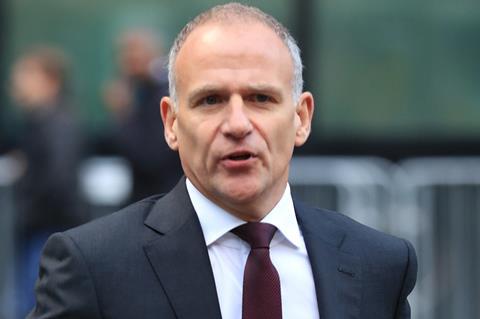
Dave Lewis has urged improvement in Diageo’s off-trade customer service, expressing surprise at systems and processes he described as “just not fit for purpose”.
Speaking to media for the first time after starting as CEO at the multinational spirits giant last month, the former Tesco boss identified improving service levels in both the on and off-trade as a key priority for Diageo as it looks to turn around flagging sales.
Last week, Diageo GB announced it had expanded its field sales team in its domestic market, more than doubling its independent on trade and convenience team with 100 new roles.
But the build back of on-trade relationships post-Covid had been “slow and patchy”, and significant improvements were still needed in the off-trade to drive sales, Lewis said.
“Our customer service in the off-trade is frankly really very poor,” Lewis said. “The customer service levels I experienced in North America, Latin America, and the UK… really are not acceptable. When we’re looking for growth, the idea that we can’t service the demand that is there is a source of significant regret, but it’s also an opportunity for us.”
Manual approach
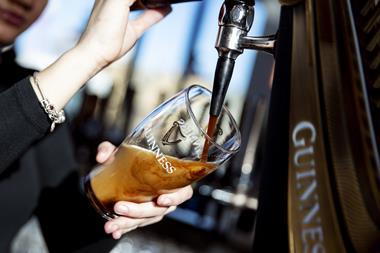
While capacity constraints on Guinness were “a big part” of the problem, Lewis said that manual order processes Diageo had in place in the off-trade were driving down availability and awareness of its brands in the channel.
“If I told you that 60% of all the orders that Diageo enters are entered manually, it would give you some semblance for how developed those processes are,” he said. “We need to address this. We need to start to build joint business plans for the development of the business, but also the execution of the business.
“Ultimately, our approach to our customers must be that we grow our customers’ categories and we look to gain disproportionately from that growth. We grow with our customers, [and this is a] significant opportunity for Diageo.”
In a call with analysts, Lewis added while he was at Tesco his impression was that Diageo was a business that had “phenomenal” brands but “engaged operationally” with retailers in a way that was “not best in class”.
“Having now been inside the Diageo business for seven weeks I can say that we have not invested in the systems and processes that would make it a professional operation,” he said. “There is a whole area of transactional engagement with customers operationally we can and should improve. That will do two things if we do it well: It will lower the cost of servicing our customers and it should also free up cash.”
He added: “I want us to start thinking about how we grow with our customers rather than thinking about how we grow through our customers. That’s a subtle difference but if we’re able to do that then that will yield more value to our shareholders.”
Premiumisation rowback
Alongside improvements in customer service, other priorities for getting Diageo back on track were to develop “competitive category strategies” and create a “more agile Diageo operating framework”, Lewis said.
The former could lead to the Johnnie Walker supplier rowing back on its premiumisation strategy in certain markets and on certain brands, he revealed.
“The premium portfolio is a massive asset and we will continue to invest in it,” he said. “But we will also, in addition, explore new portfolio opportunities. That might involve some price repositioning and it might open up new proposition spaces.
“In addition, we need to sharpen our price pack architecture and particularly address the opportunity … in the growth of small packs.”
Lewis told analysts any price repositioning would be done “surgically” and on a market-by-market basis based on where the supplier believed it could unlock volume growth from cutting prices.
“There are a whole bunch of people at the moment who not enjoying a Diageo brand in our core categories,” he said, noting it was important that the business had a portfolio that was “effective in the prevailing economic conditions”.
“I don’t want Diageo to be a business that has to rely on the economic temperature to be successful,” he added.
Tequila sales slide
Sales at Diageo fell by 2.9% in the six months to 31 December, driven by declines in North America and China. In Great Britain, sales climbed 2.9%, led by the performance of Guinness.
Tequila was a particular drag on sales, with Diageo’s brands declining by 23% in North America as the Don Julio and Casamigos owner battled “pressure on consumer wallets and an increasingly competitive environment,” according to CFO Nik Jhiangiani.
Spirits category softness was exacerbated by “ongoing tequila litigation and media on additives and adulteration,” Jhiangiani said. Diageo is currently seeking the dismissal of a lawsuit in New York that alleges its tequilas are not made from 100% blue agave.
Jhiangiani reiterated Diageo’s belief that the claims were “baseless”, adding the company was also “working with industry influencers to inform the narrative”.
Diageo now expects its full-year sales to decline by between 2%-3% in fiscal 2026, compared with flat to slightly down previously.
Organic operating profits, meanwhile, are expected to be flat to up low-single-digits, compared with a previous forecast of low-to-mid single-digit growth.
Despite ongoing struggles and a £22bn debt pile, Lewis emphasised Diageo was not actively looking to sell any major brands, including Guinness.
“If somebody were to approach us and make an offer that we can’t refuse for portfolio assets which are not part of our strategy, then… we will obviously listen and engage,” he said. “What I want to be clear on is [that] we’re not we’re not actively out in the marketplace hawking a whole series of what people have called ‘tail brands’.”
Diageo shares were down 8.1% in mid-morning trading, but remained up 6.9% in the year-to-date.



No comments yet