






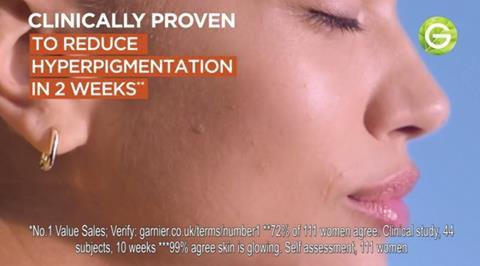
L’Oréal has drawn the ire of the ASA for making a “misleading” claim about its Garnier Vitamin C Serum’s ability to reduce dark spots in two weeks.
The video-on-demand ad, viewed in October, featured a model holding the product to camera before applying it to her skin. A close‑up of a dark spot on her face was highlighted using computer graphics.
The voiceover said: “Dark spots? Take one brighter step with new Garnier Vitamin Cg Serum. Now with a 4% active concentration, clinically proven to reduce hyperpigmentation in two weeks.”
Small print at the bottom of the screen stated: “72% of 111 women agree. Clinical study, 44 subjects, 10 weeks”.
A complainant challenged whether the “clinically proven” claim was misleading and could be substantiated.
In response, L’Oréal said the small print shown in the ad had been included “in error” and was “inaccurate”. It said the claim should have referred only to a “Clinical study, 44 subjects, 10 weeks”. L’Oréal acknowledged that the inclusion of the wording “72% of 111 women agree” in the small print could have caused “confusion between subjective and objective claims”. The company said the wording would not appear in its current form in future communications.
L’Oréal added that the product formulation contained niacinamide, ascorbyl glucoside and Melasyl, ingredients known for their anti‑pigmentation effects, and submitted an unpublished clinical trial alongside a published paper on Melasyl to support the claim.
Despite this, the ASA upheld the complaint. It said the evidence was “not adequate” to substantiate the claim, citing a flawed clinical trial methodology. The watchdog said there was “no evidence to support whether the sample size used was big enough to be clinically robust”.
It also questioned whether the results were representative of typical UK use, noting that the study was conducted in a country with a “sunnier climate than the UK”. The ASA said this did not reflect how UK consumers would expect to use the product in everyday conditions.
While some “statistically significant differences” were observed after two weeks trial, the ASA said the changes were “small and only seen among a minority of subjects”. It also considered the study to be a “subjective, self‑reported” result that was ”not adequate to substantiate a ’clinically proven’ claim”.
The published Melasyl study, meanwhile, was considered irrelevant because it focused on preventing UV‑induced pigmentation rather than treating established hyperpigmentation, the ASA added.
It concluded that the claim was “misleading” and breached three CAP Code rules on misleading advertising, substantiation and beauty products. The advert must not appear again in its current form.
A spokesperson for Garnier told The Grocer: “While we respect their decision, we are naturally disappointed as we stand firmly behind the science and the testing results for this product.
“To ensure this serum worked for everyone, we carried out a thorough clinical study, specifically designed to test its effectiveness at reducing dark spots. We know that hyperpigmentation and darks spots can be made worse by sun exposure, and our study was carried out in a sunnier climate – while making sure to include a broad range of skin types. This approach is in line with the industry standards for this type of research.
“The clinical study clearly demonstrated that the serum works, and eight out of 10 people who took part saw a visible reduction in their dark spots – and those results were robust and scientifically validated. While we respect the ASA’s role and will follow their guidance, we remain proud of this formula and the results it delivers for our consumers every day.”
This is not the first time L’Oréal had been rapped for hyperpigmentation, an advert for La Roche-Posay in September was upheld for not making sensible comparisons.












No comments yet