




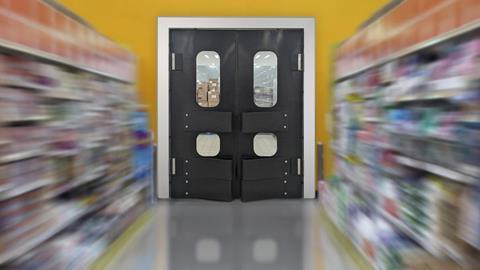


Unlocking shop-floor efficiency savings starts with innovative infrastructure. Discover how the right high-spec doors can unlock energy-saving gains while improving everything from food hygeine to worker safety.
The everyday physical infrastructure built into supermarket design might be easy to overlook, but it’s an increasingly business-critical part of any major retailer’s operations.
Think display cabinets, stockroom storage or the industrial doors that quietly connect a complex store ecosystem, through which people, products, equipment and waste are constantly moving.
As pressure grows to eke out cost, energy and efficiency savings, so does the need to optimise this ‘hidden’ connective tissue within modern stores.
Against this backdrop, specialist manufacturers such as Birmingham-based Kenfield are gaining traction. The company, which has supplied some of the UK’s biggest supermarkets since 1983, provides retailers with products that deliver everything from energy savings to food hygiene and worker safety.
‘A springboard to a new market’
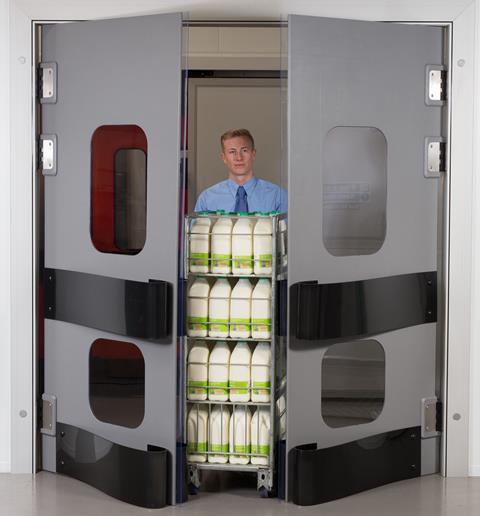
For decades, supermarkets relied on little more than PVC strip curtains to connect the many different environments within their stores – from loading bays to chilled storage, bakeries and delis.
The curtains were light and easy for staff to move through while carrying large deliveries or wheeling out trolleys of out-of-date stock at the end of a shift. But they often lacked the robustness needed for heavy-duty or temperature-controlled areas.
The first requests to replace them with proper doors came from retailers themselves, says Jon Carn, managing director at Kenfield, which has been a leading supplier of PVC curtains since it was founded in 1983.
“We were listening to our customers’ feedback – they were saying, ‘can we improve on that?’ And in developing that first door, it was a springboard to a new market, a market that hadn’t existed before.”
“Energy is without a doubt still one of the most prominent topics that somebody approaching us would focus on.”
Jon Carn, managing director at Kenfield
Developing a door fit for the cut and thrust of a modern supermarket – one that balances competing demands for hygiene, safety, durability and efficiency – proved surprisingly complex.
“It’s an obvious metric but not all doors close,” says Carn. “You’ll notice if you walk around stores that doors are open all the time because hinges develop problems, debris becomes stuck or there’s some engineering issue. We tried to manage that out through the design of our hinge.”
When developing the hinge for its latest door, the K150, the team carefully researched the exact force – measured in newtons – needed to open it, to reduce the risk of strain injuries among staff. It also designed seals that store teams can replace without an engineer, as they inevitably wear faster than the door itself. “All of these elements are important, but they’re unseen,” says Carn.
Energy savings are another priority, and a vital one for retailers working towards ambitious carbon reduction targets. Heavy conventional doors are often propped open or left ajar during busy periods so staff can keep pace with the work, allowing significant amounts of thermal energy to escape.
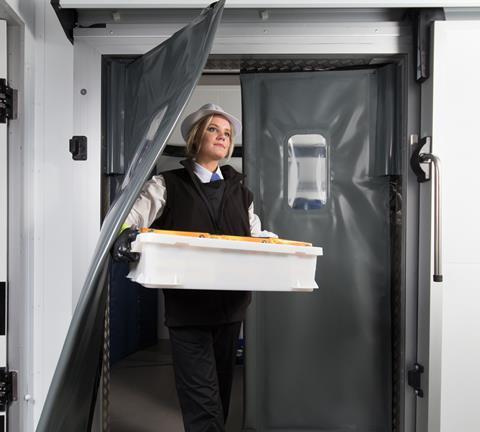
Kenfield’s answer is the K750, a flip-flap cold room door with flexible, self-returning panels that let staff pass through in either direction without stopping to open or close it, helping to keep temperatures consistent. The company says it can cut energy use by up to 50% compared with an unhooked or poor-quality PVC strip curtain. The K750 won Kenfield an RAC Cooling Industry Award in 2018.
Tough enough to survive daily retail punishment
That kind of innovation has helped many of the UK’s biggest grocers recognise the value of this once-overlooked part of the store. Kenfield has supplied more than 40,000 doors to the sector, and Tesco, Sainsbury’s, Aldi and Farmfoods have all specified them for a number of years.
At Farmfoods, the search for replacement doors began in 2018, when head of property development William Scanlon noticed existing doors kept breaking or deteriorating quickly. The retailer switched to Kenfield in 2022 and hasn’t looked back.
“Look, it’s difficult to get overly excited about something like this because they’re just doors, but they do exactly what they’re supposed to do,” he says. “They’re in high-traffic, high-impact environments and they just take it and say, ‘is that all you’ve got?’
“Thinking of the pallets that we bring through on to the shop floor, there’s maybe an articulated lorry load every day coming through those doors on pallets, back and forth, day after day, all but two days of the year. They’re just very, very robust.”
The wipe-clean finish makes hygiene maintenance straightforward, he adds, and the doors also act as a useful barrier for climate control.
Building a global presence
Kenfield continues to develop its range to meet retailers’ changing needs.
“Energy is without a doubt still one of the most prominent topics that somebody approaching us would focus on, but they’re also looking at aspects like the longevity of the product – that’s key,” says Carn.
“A ‘fit and forget’ type product that is going to be in store for years is very attractive to them. So we focus on that, trying to create products that survive in a very tough environment over a long period of time.”
The K150, for example, has durable seals that maintenance teams can easily swap out and teardrop bumpers that flex on impact and spring back into shape. Its new acetal and steel hinge is designed to return the door to its central closed position time after time, even in the toughest environments.
Convincing retailers to invest in everyday store infrastructure is far less of a challenge than it once was, says Carn. “We’re benefiting from all that hard work that was done originally within the design process, because the market, pretty much wherever we go at the moment, is receptive to solving those same problems.”
That extends beyond the UK. Kenfield now ships its doors across Europe and as far afield as the Middle East, Asia and the US, where it works with major supermarket chains including Kroger and US Foods. In the Caribbean, the K750 is the door of choice for retail group Massy Group.
Store doors were once passed through without a second thought. Now retailers recognise how instrumental this everyday infrastructure can be – and how the right innovation can open the door to unexpected business benefit
Find out how Kenfield can open doors for you at www.kenfield.com