Supermarket loyalty schemes are now a core strategic lever within UK food and drink. While 95% of Britons aged 16-75 possess at least one supermarket loyalty card, nearly 4 in 5 (79%) use multiple cards, suggesting that true loyalty to a single supermarket is rare, according to research by Ipsos.
Rather than just dishing out points or coupons, the majority now champion exclusive pricing and promotional tiers, repositioning loyalty cards from a primarily marketing or engagement tool to a must-have membership item for any shopper motivated to cut down on their grocery bill. As a result, fuelled by the cost-of-living crisis, these loyalty schemes now directly shape and influence shopping behaviours. ‘Loyalty benefits’ are consistently ranked among the top purchase drivers, in quarterly polls of 3,000 UK adults by KPMG, only beaten by price, quality and convenience.
But while retailers double-down on these schemes – only in April, Sainsbury’s partnered with Uber and Uber Eats to allow customers to redeem Nectar points for rides and food deliveries – their full potential is yet to be harnessed by suppliers.
“Currently, retailers are taking a lead role in designing these loyalty promotional plans with limited input from manufacturers,” says Shashank Dewan, partner in pricing strategy at KPMG UK. “But, by playing a more active role in shaping campaigns and mining the insights from loyalty data, [fmcg] manufacturers can use them as a tool to unlock a far better return on trade investment – and reap their fair share of the potential rewards.”
From discounts to data-driven growth
“Loyalty programmes have evolved from simple discount engines into powerful, data-driven growth platforms,” notes Ben Snowman, head of loyalty, personalisation, services and strategic alliances at Dunnhumby. “[As a result], loyalty is now one of the few channels where retailers and brands can both influence behaviour and prove ROI with confidence,” he adds. “This makes it less of a marketing add-on and more a core route to sustained customer relevance and growth.”
Some leading suppliers have already recognised this potential, leveraging loyalty schemes as an invaluable way to both understand and reach shoppers at massive scale.
At Samworth Brothers, for example, the manufacturer used loyalty insights to craft an insight-led promotional plan for the pies and savouries category a few years ago, after poor-performing promotions created a risk of losing in-store space. Drawing on the learnings of loyalty schemes at multiple retailers remains an important area of focus, says Richard Cole, the company’s category director for savoury pastry. “Identifying good value propositions that offer consumers a compelling benefit to trade up is critical. Loyalty data helps ensure promotions and pricing that achieve this are on target.”
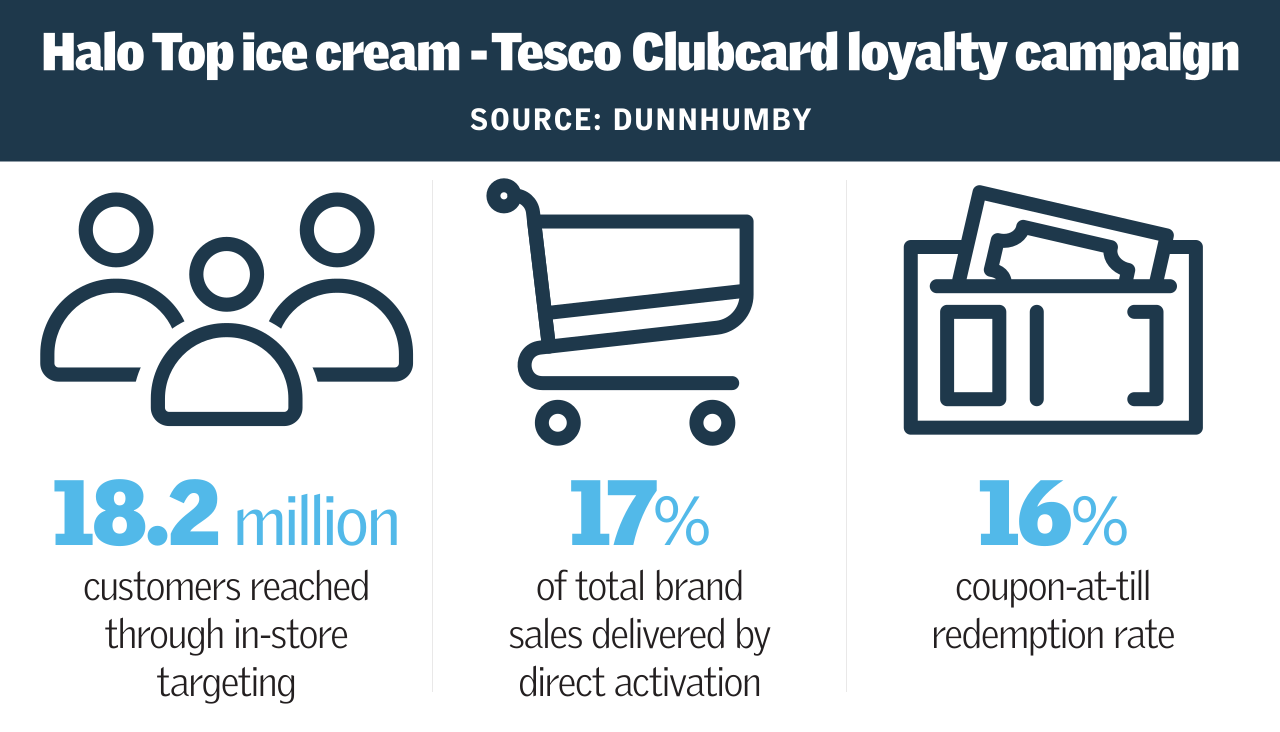
Similarly, when US ice-cream brand Halo Top was to set to debut in the UK back in 2018, it used the breadth of Tesco Clubcard data to both understand the different types of consumer that may be open to and interested in trialling the brand, and then engaged them via targeted promotions, explains David Taylor, co-founder of brand licensing and product development agency Brand of Brothers, who spearheaded Halo Top’s UK distribution and marketing. In fact, working with Dunnhumby and Tesco, the brand developed a multichannel campaign, including targeted in-store activation that reached 18.2 million customers, delivered 17% of total brand sales and achieved a 16% coupon-at-till redemption rate, according to Dunnhumby.
“It’s fair to say that the launch in Tesco was recognised not only within Tesco’s own business, but also in the wider retail landscape as being one of the most effective in recent history,” remembers Taylor. And although the brand has now carved out a sizeable niche in the market and become less reliant on loyalty data, he’s clear about its significant ongoing value. “Without Clubcard we would not continue to have the insight into our shoppers’ habits and lifestyles, allowing us to communicate with them in the most appropriate ways and means.”
Unlocking benefits within the loyalty ecosystem
By becoming more active participants within a broader loyalty ecosystem, suppliers can unlock all sorts of capabilities that go beyond data, believes Dewan.
For example, by understanding the mechanics of different schemes – they can focus investment on the ones that most closely align to their customer proposition and commercial objectives. That could include using more rewards-led schemes for repeat-purchase SKUs or in habit-forming categories, and more mission-led schemes to emphasise fresh, premium or health credentials.
There is also the potential for suppliers to influence broader value perception, Dewan adds. This may include reinforcing brand equity via retail media housed within a loyalty scheme or ensuring hero SKUs are anchored on a value perception, at a strategic price point (rather than simply the cheapest).
Loyalty programmes also change what sells, not simply how much, he points out. They can encourage shoppers to trade up or down – and can even create intra-portfolio switching risks. By taking a more active role, suppliers can help manage this, designing the roles of each SKU explicitly within a given loyalty ecosystem, rather than by category. This can help enable more strategic trade-ups via premium variants or bundle offers, or drive acquisition via entry price points or promotions.
Currently, these capabilities remain underutilised by suppliers, believes Snowman. “Most brands are still under-leveraging this capability, treating loyalty as a promotions channel rather than a strategic platform for engagement and relevance,” he says. “[But] those retailers and brands that embrace modern capabilities can influence how value is constructed and how returns are compounded through continuous optimisation across a growing range of personalised levers.”
Reshaping the possibilities of a loyalty ecosystem
There are three practical steps that teams can take here to reshape their existing approach, recommends Dewan.
First, define the role of loyalty within a wider Revenue Growth Management strategy on a retailer-by-retailer basis, rather than as an aggregate plan. “Diagnose how each scheme shapes shopper behaviour – for example, frequency vs. basket size vs. mission-based shopping,” he says. “Map your categories and SKUs against those roles and identify where loyalty should replace or complement current promotions.” He advises using this as the framework for a retailer-specific loyalty playbook linked to commercial priorities.
Second, execute this playbook with precision, with different plans by retailer, channel and mechanic. “In an increasingly personalised pricing world, the more targeted the better” warns Dewan. For example, online audiences tend to respond to more dynamic, substitution-driven promotions, whereas in-store, the focus should be on clearer price signalling and the visibility of loyalty savings. “Use retail media as a value amplifier here,” he suggests.
Third, measure what matters – and iterate fast. “Traditional analysis is too slow and too blunt,” says Dewan. Think granular too. For example, measurement should include the impact on incremental margins, rather than simply uplift. “Manufacturers should also consider carefully the retention and repeat behaviour of loyalty-activated shoppers too, using test-and-learn systematically to optimise an approach.”
“Those who treat loyalty as a passive funding line will see margins erode. Those who actively shape how loyalty is used – by retailer, by SKU, and by shopper – will unlock significant returns.”
Shashank Dewan, partner in pricing strategy at KPMG UK
Proactive, not passive
The bottom line is that suppliers and manufacturers who fail to take a more proactive stance on leveraging supermarket loyalty schemes are missing out on opportunities to drive growth, build brand awareness and reach engaged shoppers.
As Dewan puts it: “Those who treat loyalty as a passive funding line will see margins erode. Those who actively shape how loyalty is used – by retailer, by SKU, and by shopper – will unlock significant returns.”