




UK supermarkets are failing to capitalise on plant-based growth despite widespread availability, with weak in-store promotion holding back sales and repeat purchases, according to a new report.
Drawing on store audits taken from 10 UK grocers, alongside market data and industry interviews, the report, which was co-authored by ProVeg International and Planeatry Alliance, finds the category is “stocked, but not sold”.
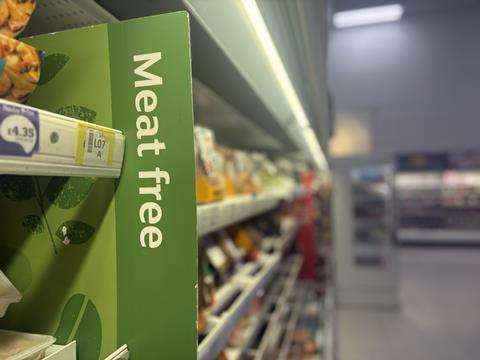
While supermarkets have largely succeeded in getting plant-based products onto shelves, in-store activation and navigation lags behind. The audits revealed gaps mean the plant-based category remains hard to shop, with little or no signposting, poor shopper communication and limited messaging.
Even the highest-performing supermarket scored less than half of the top score for in-store execution, with none of the grocers including plant-based options in their wider corporate communications.
Launched during London Climate Action Week, the report introduces a five-stage “stocked to scaled” framework – spanning stocking, signposting, shoppability, selling and scaling – to help retailers convert existing availability into sustained growth.
“The real opportunity is not simply putting more products on shelves,” said Joanna Trewern, partnerships director at ProVeg International.
“Retailers have largely achieved distribution. The next challenge is helping shoppers discover products, understand how to use them, and buy them again.”
Plant-based evolution
The findings push back against the narrative of a category in decline, arguing plant-based is “evolving, not disappearing”.
While some meat alternative products face pressure, dairy alternatives remain resilient, growing 2.2% to £812.3m in the past year, with yoghurt alternatives up 12.3%. At the same time, ingredient-led proteins are emerging as a key growth engine, with year-on-year growth in tofu, tempeh, beans and pulses driven by consumer interest in protein, fibre and clean ingredients.
Tofu saw a value growth of 15.3% and volume growth of 25.2%, while Tiba Tempeh recorded a 736% surge in retail sales
According to ProVeg, this growth remained strongest where products felt “normal, useful and easy to buy”, with dairy alternatives now part of consumers’ everyday shopping habits.
The report highlights the importance of embedding plant-based into wider commercial strategy, including clearer category ownership and long-term targets. It also argues that protein diversification should be a strategic priority for retailers facing volatile commodity markets and shifting consumer demand, with a broader protein mix improving “resilience, relevance and long-term category growth”.
“The lesson for retailers is that plant-based should not be treated as a single category with a single growth strategy,” Trewern added.
“Protein diversification is becoming a retail resilience issue. Retailers that build stronger, more balanced protein portfolios will be better positioned to respond to changing consumer demand and future supply chain pressures.”









No comments yet