



When every pound is under scrutiny, the safe move is to spend less. So why are the boldest fmcg brands doing the opposite? Here’s the case for investing in brand when the market says cut.
Cut the budget. Wait for things to settle. Play it safe. It’s the obvious move in a tight market – and it’s exactly what fmcg’s boldest brands are refusing to do. A growing number are investing harder in the things that make them unmistakable: a sound, a face, a line, a feeling. Their bet: when shoppers are weighing every pound, the brands people feel something for are the ones that win.
Their conviction is being tested. UK grocery is under more simultaneous pressure than at any point in recent decades. Food and drink inflation is expected to hit 9-10% by year-end [FDF], consumer confidence has fallen for 11 consecutive months [GfK Consumer Confidence Barometer] and own label has crossed 50% of grocery volumes for the first time [Circana] – with private label now out-innovating brands on new product launches [Mintel]. What’s more, HFSS regulation has removed promotional mechanics from entire categories, regardless of brand size or budget.
“This isn’t a downturn. It’s a reset,” says Jacqui Parr, editor of thegrocer.co.uk, who opened Global’s recent FMCG Brand Advantage Breakfast. “Climate volatility, regulatory intervention, shifting health attitudes and economic pressures are all landing at once. Some models will adapt. Others will struggle. The brands that come out strongest will be the ones that adapt fastest, invest with intent, and build meaning that people genuinely value.”
There is ample evidence that brands which maintain investment through a downturn recover faster, hold their price premium better, and lose less ground to own label [IPA Effectiveness Databank], and strong brands already command twice the price premium of weaker equivalents [Kantar]. The question fmcg teams are wrestling with is how to make that case internally when CFOs are scrutinising every pound.
Gerry Anyanwu, fmcg client development director at Global, is unequivocal. “Supporting brands to keep investing comes down to showing what works and why. McCain and Warburtons continue to excel because they’ve proven they can shift price and increase profitability. If you can prove business outcomes and consistent return, you can help any marketing director secure healthy budgets.”
Three principles for building brand advantage
Global believes brand building rests on three principles: winning emotion at scale; building consistency through distinctive assets; and understanding what works with sophisticated and easily accessible measurement tools.
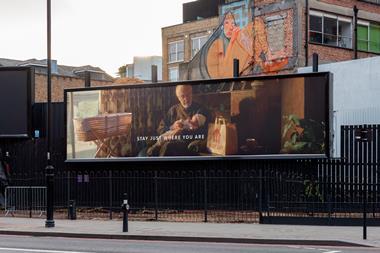
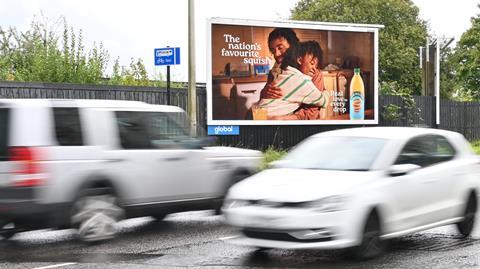
The first principle reflects a structural shift in how fmcg brands compete. “Brands don’t grow just because they’re being noticed,” says Anyanwu. “They grow because they’re being felt. Emotions build memory, and memory builds differentiation and preference. Large-format outdoor delivers that impact at scale.” Consumers perceive brands on large formats as worth nearly twice as much as those on smaller devices such as mobile phones [WPP Media]. The physical presence creates brand stature.
Audio deepens that emotional connection with customers. “Audio is personal, emotive, immersive,” says Anyanwu. “You’re not just selling shampoo – you’re selling amazing hair. Audio delivers the emotional benefit and brings a product to life.”
“Sweat your assets. That’s what creates nostalgia and heartfelt emotional connections.”
– Gerry Anyanwu, fmcg client development director, Global
Tesco’s ‘Drizzle’ campaign combined large-format food visuals with audio storytelling around flavour and provenance – a mouthwatering, multi-sensory campaign, in Global’s words. The mix of outdoor’s public scale and audio’s intimacy creates what Global calls a ‘priming effect’: the brain recognises the visual ad and encodes the message it heard in the audio.
Stick with what’s distinctive
The second principle is consistency of distinctive assets. Tom Ireson, head of strategy at Global, points to a gap many fmcg brands have not closed: around 80% of advertisers have visual brand guidelines but only about 20% have an audio equivalent [Radiocentre]. “Most brands are extremely disciplined visually and much less disciplined sonically,” he says.
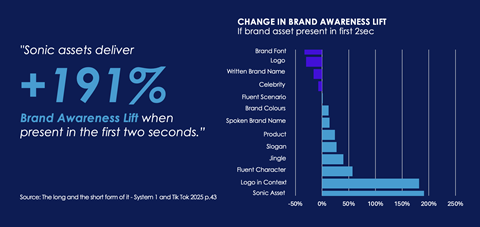
“Consistency turns individual impressions into brand memory. If your look is managed but your sound is improvised, your advertising will be less impactful.” Sonic branding makes a brand recognisable in seconds: assets presented in the first two seconds of social video deliver a 191% brand awareness uplift, higher than any other brand cue [TikTok/System1].
That discipline matters most when budgets are tight. Ireson calls the answer ‘minimum viable consistency’. “It’s the discipline to keep a small number of things consistent – a voice, a line, a sonic cue, a strong idea,” he says. “If a brand’s under pressure, the worst thing it can do is reintroduce itself every time it advertises. Pick a few distinctive cues and rather than changing them; let everything else flex around them.”
The reason Ireson hears most often is that a creative is too visual for audio. He points to a Skittles campaign that Global’s team worked on with Mars – all bright colours and giant-eyed characters. “The challenge was, this just won’t work in audio. But the team worked with comedians and improvised to convert it.” Run as a regional test, it outperformed TV on ROI and lifted sales by 9% [Global/Mars]. “There’s always a route – that’s the beauty of the theatre of the mind.”
Warburtons is a case study in consistency, featuring a succession of A-list voices (Olivia Colman, Morgan Freeman and Samuel L Jackson) across TV, radio and digital audio. “Too many brands have an idea, don’t invest in it, then decide it didn’t work and move on,” says Anyanwu. “The mistake is not having the courage to stick with your assets. Sweat your assets. That’s what creates nostalgia and heartfelt emotional connections.”
Just Eat is another example: its sonic identity is so embedded that seeing the logo triggers the audio: ‘Did somebody say Just Eat?’ Dr Pepper’s recent sonic asset, by contrast, originated on TikTok, where a US creator, delighted with the drink, filmed herself singing about it and racked up more than 45 million views. The brand spotted it and ran with it across TV and other channels before feeding it back into social. “That was almost like lightning in a bottle,” says Ireson.
“Good brands should always be listening,” he adds, “but you can’t wait for cultural lightning to strike. Make deliberate choices with your assets, and don’t confuse listening with drifting.”
Proof at speed
The third principle is understanding what works – and understanding it fast. McCain’s recent partnership with Global and Nectar generated a 133% sales uplift in the test group and a 182% purchase uplift among McCain’s target audience [DAX/Nectar 360], delivering audience, environment and device-level insight. “For the first time, we could track consumers from hearing our branded ad through to purchasing our McCain Vibes products and scanning their Nectar card,” says Megan Bell, senior product manager at McCain Foods, giving the brand “a much clearer view of audio’s role in driving conversion beyond brand awareness”.

What the newer tools add is speed, says Ireson. “Marketing mix modelling (MMM) is brilliant for the big picture but isn’t built for speed – you’re looking in the rear-view mirror. These tools let you see what’s happening and can optimise in flight; it’s not a major pivot, it’s optimisation.” It is not a replacement for econometrics, he stresses: “MMM is still the gold standard, but having both gives you a more rounded view.”
Global is building the infrastructure to make that routine. Its Amazon DSP integrationconnects audio activity directly to sales outcomes, and Global IQ, its regression-based outcomes tool now in testing, is designed to show how audio and outdoor perform from awareness through to sales – fast enough to inform a live campaign, not just the post-mortem.
The internal argument
Jasmine Patel, senior media connected planning partner at Danone, sums up the market in three words: fluid, competitive and exciting. “We have to show a return on every pound, probably more than ever. It’s not always ROI-driven – sometimes it’s metrics, such as share of conversation or sentiment. But measurement is key.”
Danone is relaunching its brand in the UK using audio – to revive the iconic ‘mmm, Danone’ jingle – and outdoor, to show the creamy texture. “They play very different roles, tapping into different senses,” says Patel. “Audio unlocks the jingle, outdoor gives you the visual. For food and drink, that’s super important.”
The challenge, Patel says, is reactivity. “Fmcg brands still find it hard to be reactive. You can be reactive in audio and podcasts too, not just social – trading scripts in and out. But in big fmcgs like Danone there are regulations and processes. We’re trying to get more agile, to really embed ourselves in culture.”
McCain has held that line for nine years, the brand having “always prioritised long-term brand awareness and brand equity over short-term promotional gains”, says Bell: a discipline it credits for growth in the frozen category and in the McCain brand since the pandemic. “As category leaders, we have a responsibility to invest in the future of frozen,” she adds. “Consistent investment builds consumer trust, drives deeper connection and, ultimately, delivers both brand and category growth.”
The opportunity, Parr argues, lies in recognising what this moment is. “This isn’t the market stalling, it’s the market relearning what works,” she says. “UK food and drink is not in decline, it’s in transition. When choice is constrained and consumers are cautious, brands that genuinely mean something still matter – they give shoppers permission, reassurance and a shortcut. The brands that understand that and invest accordingly are building resilience for what comes next.”
THE NUMBERS BEHIND THE BRAVE
53% – own label’s share of new food and drink product launches in 2025, up from 18% in 2000 (Mintel)
9-10% – expected UK food and drink inflation by end of 2026 (FDF)
2x – the price premium strong brands command over weaker equivalents (Kantar)
191% – brand awareness uplift delivered by sonic assets in the first two seconds of social video, higher than any other brand cue (TikTok/System1)
133% – sales uplift in the test group from McCain’s audio campaign via Global’s Nectar partnership (DAX/Nectar 360)
78% – of UK consumers report seeing outdoor advertising in their local area, making it the most visible channel after TV (Global/YouGov)