


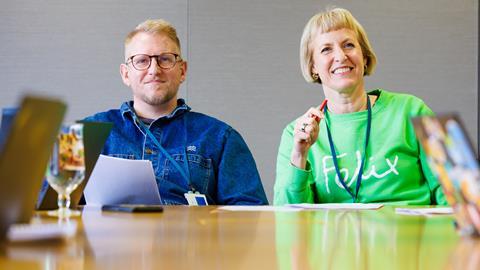
Kris Gibbon-Walsh of FareShare and The Felix Project’s Charlotte Hill on their merger, ‘bin-shaming’ and government intervention
Tell us about the merger. How and why did it happen?
KGW: When Charlotte and I sat down it became clear really quickly there was very little actual overlap between the two organisations operationally, but we were starting to get in each other’s way, whether that be with the food industry or funders or brand exposure.
You start to question whether we could deliver more impact together and spend hard-earned charitable income better together and could we simplify our ability to deliver for the food industry and deliver impact for the charity sector more effectively together? And the answer to all of that became unequivocally yes.
CH: The thing I keep coming back to is that less than 1% of the surplus food that is available is redistributed. And yet in other countries it’s 5%-6%-7% or even up to 12%. And one of the barriers to that happening is a fragmented food redistribution sector. So we’re simplifying the sector. Kris and I couldn’t look ourselves in the mirror if we’d done all the due diligence and not really understood we’d be better being one charity rather than two.
Why did you decide to keep the Felix name when FareShare is better known?
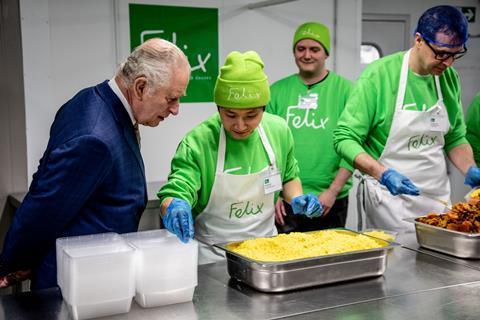
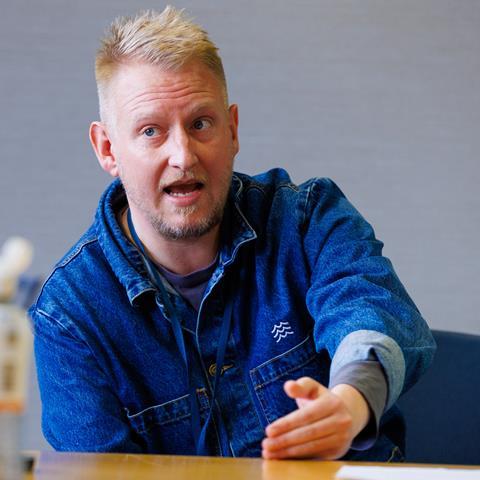
KGW: The Felix brand – Charlotte’s wearing it now – that’s Felix’s signature [the late son of founders Justin and Jane Byam Shaw, who died from meningitis in 2014 aged 14]. We knew that was really powerful as a brand for the future and something I was really happy with. We need a simpler, penetrative, longer-term brand.
CH: We haven’t formally announced what the name of the new organisation is going to be. That will be coming in the next six weeks or so. But it will be, as we announce at the merger, focusing on the Felix signature.
The Grocer last week revealed talks at No 10 on a new food waste strategy. How significant could this be?
CH: It’s a really big opportunity. This isn’t something just for government to solve, it’s something the voluntary sector, the food industry, government, all need to lean into and play their part in. We know that in other countries where we’ve seen a significant step-change in food redistribution, government has had to step in in some way. Whether that’s around subsidies or Good Samaritan laws or tax incentives or mandatory food waste reporting, there is a role for government to play. We hope that the fact this was at No 10, that it brought lots of different government departments together alongside the food industry and the voluntary sector, indicates the government are serious. We’ll keep on pushing to make sure it wasn’t just a photo opportunity.
The King’s Coronation Food Project and resultant Alliance Food Sourcing operation were billed as a game-changer. Have they done enough?
CH: We’ve got to remember it’s only a couple of years in. I think the leadership of His Majesty in particular has really helped with the convening of the food industry but it’s really early days. The Coronation food hubs, which we now have in south London, Merseyside and others coming down the track next year, have had some great investment in infrastructure. We now need to see the government and others playing their part to ensure the food can flow through.
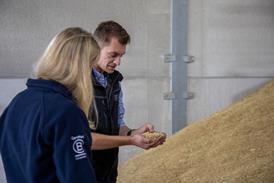
How realistic is it that a farmer will spend time and money on food ‘wasted’ before it’s even out of the farmgate?
KGW: I totally understand why a farmer is going to struggle, depending on the scale of their farm, to go back into their fields and plough crops that they know they can’t sell to give to organisations like ours. However, I know that they would agree that it would be good if there was a cost-neutral way of getting that food out of the ground.
CH: Shout out to The Grocer here. Ten years ago, the Waste Not Want Not campaign was kicked off by The Grocer. So this isn’t new, these are conversations we’ve been having with government for a long time now. We all know the food is there. What we can’t keep doing is going from one year’s funding to the next on a cliff edge.
The government offered a £15m pot last year to help farm surplus (of which it gave £13m). Are you saying this needs to happen every year?
CH: Yes, and there’s different ways the government could go about that. It could be through the Environmental Land Management programme and a subsidy of some sort to farmers. It could be a wider tax incentives piece that includes farmers and others in the food industry. But what we can’t have is stop-start.
The Downing Street talks raised what used to be called mandatory food waste reporting, now called common data standards because it doesn’t scare the Treasury so much. Will this finally happen?
CH: If you can’t measure it, it’s very hard to report against it. Common data is not the panacea that is going to lead to the big significant step-change that we’ve talked about, but it absolutely will be part of the jigsaw.
The Grocer understands ministers are enthused by the role AI can play. Do you agree?
KGW: AI isn’t a silver bullet, but it can contribute significantly both to our ability to move and allocate food to where we can deliver the most social impact, and to the food industry’s ability to know when it will no longer be possible to sell it. However, if the data isn’t reliable, then it will make mistakes and lead us in the wrong direction.
Social media’s ‘Food_waste_ inspector_’ has been causing a stir with posts ‘shaming’ supermarkets like Lidl, M&S and Waitrose over binned food. Is this fair?
KGW: I’ve got some strong views on this. Retail is 2% of the total amount of edible food waste in the supply chain and store level retail even less. Rather than focusing on where we get loads of food that’s really high-quality, nutritious and in date, it’s focusing on where it’s shorter date and where it’s a tiny proportion. We’ve got a very accurate picture at store level of this kind of thing and retailers we work with are doing a really strong job. Most are thousands of times better than they were 10 years ago.
How will you ensure your merger strengthens upstream waste prevention without normalising surplus?
CH: We say very clearly, working alongside our colleagues at the Joseph Rowntree Foundation and Trussell, food redistribution isn’t the answer to poverty. But we want to make sure we maximise the ability to get food from every part of the system where it’s unavoidable for it to otherwise become surplus.
KGW: Equally if the food industry finds ways to design out food waste completely and sell every single product, we would celebrate that and like any good charity we would go and do something else.
Why is the UK not doing as well at food redistribution as countries like the US, France, Spain, Poland, Italy and Portugal?
CH: Feeding America is the second-largest charity in the US. And in the US, whether it’s through Good Samaritan law or tax incentives, they’ve seen a really significant step-change. But they also have a consolidated food redistribution sector through Feeding America. Partnering with the food industry, it has all the right regulation and legislation from government and is able to distribute at a huge scale. It’s government, the voluntary sector, the food industry, all coming together. This is my fourth charity chief executive job and the first one, if I’m honest, where I’ve thought, you know what, that step-change we’re talking about is eminently possible.

No comments yet