




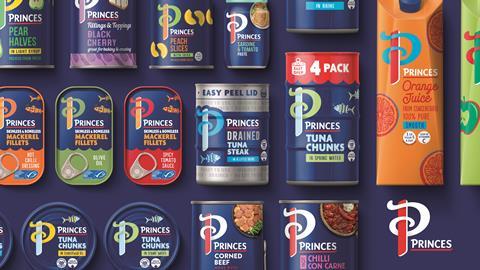
Last week, Princes informed retailers of a 5% price hike across its range. Other manufacturers will be watching closely how the move plays out
As the Iran war pushes up costs, Princes has fired the starting gun on price rises. Princes commercial chief Giuseppe Mastrolia gave retailers nine working days’ notice of a minimum 5% price hike across all its products from 1 April, The Grocer revealed last week. Notably, it dispensed with the usual 12-week negotiation period.
In a letter to Princes’ customers in the UK and Europe, Mastrolia said it faced a 50%-60% increase in energy and fuel prices, a 40%-120% rise in shipping, logistics and insurance costs, a 10%-25% hike in raw materials and packaging costs, and a 20%-40% spike in agricultural inputs and fertilisers.
“The closure of the Strait of Hormuz… is generating unprecedented cost pressures across the entire food and drink industry,” Mastrolia wrote.
So, will retailers accept it? Will it open the floodgates to a new wave of CPI requests from others? And how reflective are Princes’ demands of input cost pressures stemming from the Middle East conflict so far?
Shipping costs
Princes’ estimated 40%-120% jump in shipping costs is not yet reflected in the wider market. According to respected benchmark Drewry, container prices increased 20.4% between 26 February, two days before the conflict started, and 2 April.
While crude oil prices have shot up 51% since the war began, according to Expana, and natural gas by 57%, most of the inflationary effects have yet to feed through.
Container prices remain well below the highs seen in summer 2025, when Yemen’s Houthi faction forced the closure of the Red Sea shipping route.
“Given how long the conflict has been going on, those figures [from Princes] feel quite ‘toppy’,” says management consultancy Argon & Co partner James Watson.
“Often the more advanced suppliers will lock in these prices for a very long time. They trade on it, and insulate themselves from shocks as a result.”
Watson suggests Princes “could be using this [the war] as a reason to put through a price rise that’s been long overdue”.
Princes won’t only be facing costs from the Hormuz closure. Like other suppliers, it will also be adjusting to EPR fees, as well as rising labour costs following last year’s hike to employer National Insurance, notes Sentinel Management Consultants CEO David Sables.
Another senior retail source says: “The cost flow they’re quoting won’t have been seen yet as they’d be hedged on most things, other than perhaps fuel.”
The source believes other factors will be at play. They point to Princes’ maiden set of financial results as a public company, which showed a 6.5% drop in like-for-like revenues to £1.9bn in the year to 31 December 2025.
At the same time, Princes “has held back from putting prices up to maintain its credibility while going through the IPO [in October]”, they say.
“Now that is out the way, they have made their move on the back of the conflict.”
Princes Group says the war has “driven up fuel and shipping costs across all our markets”. It is “committed to working transparently with our customers” and “will only pass on inflation where we absolutely have to”.
Previous price rises behind inflation
Pricing analysis suggests Princes has indeed been holding off on inflationary rises. The price of its products in the traditional big four has risen behind inflation – by an average of 5.6% in the 24 months to 7 April 2026 – found Assosia data analysis by The Grocer.
That build-up of pressure could arguably have led Princes to speak out too soon on the impact of the Iran war.
The FDF has predicted food inflation will hit 9% by the end of 2026 assuming the Strait of Hormuz reopens by around mid-April. The two-week ceasefire deal between the US and Iran has been strained this week, and normal shipping was yet to resume as The Grocer went to press on Thursday.
It is “way too early” to put a “blanket number” on cost increases linked to the conflict, says Retail Mind founder Ged Futter. Anyone who does “is crazy” in the face of such global uncertainty, he says. “You need to let things settle down, otherwise you may have to [raise prices] again.”
Some suppliers may feel emboldened to act sooner by Princes and its decision to abandon the usual negotiating process. That will likely depend on how it plays out.
“The big question is whether Princes has the resolve to take a hole in their turnover [from potential delistings] to protect the price increase,” says Sables.
Futter says: “Over the past four years, UK retailers have become very adept at dealing with inflation. It is where any good buyer will make their money, by batting it back.”
Since the letter was sent, out of the traditional big four and Waitrose, only the latter and Asda have raised prices on Princes’ products. They are up by respective averages of 9.1% and 5% between 19 March of 9 April, based on Assosia data analysis by The Grocer.
Retailers will ask Princes “what they will get in return”, says a senior retail source.
“The big ones that have a balanced relationship with Princes will get most of the rise back through more promotional activity and retail media buy-in, and other mechanics.”
Retailers cannot push back indefinitely. Alongside energy, fuel, haulage and all the other rising costs, the war-driven rise in agricultural costs will cut directly into margins. Hauliers have added emergency surcharges, and the cost of imported ammonium nitrate fertiliser rose by 29% between February and 20 March, according to the AHDB.
McBride last week introduced a special surcharge, telling investors crude oil prices had begun to impact the cost of both the chemicals it uses to make its own-label cleaning products and the packaging they go in.
The food market’s sensitivity to inflation and lower direct exposure to oil prices may mean other manufacturers are slower to make CPI requests, suggests Sables. But Princes has helped prepare the ground.
As he says, suppliers will be “grateful it is Princes, not them” to make the first move.






No comments yet