





UK retailers are under growing pressure to reduce Scope 3 emissions – the indirect emissions generated across supply chains through purchased goods, agricultural production and product use. With Scope 3 emissions accounting for between 70% and 90% of many food businesses’ carbon footprints, attention is increasingly turning upstream in search of meaningful carbon reductions.
Packaging, refrigeration and transport remain important. But one of the most significant – and least visible – opportunities sits much earlier in the supply chain: livestock nutrition.
Across dairy, beef and poultry supply chains, embedded agricultural emissions account for a substantial proportion of total environmental impact. As scrutiny intensifies around deforestation-linked commodities and imported feed ingredients, I believe the use of palm-derived fats in livestock rations deserves far greater attention than it currently receives.
The hidden palm oil exposure
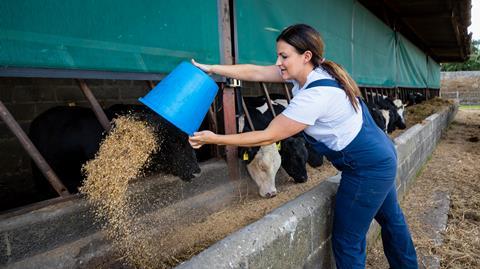
High-energy livestock diets in the UK have long relied on palm-derived fat supplements. These products provide concentrated energy and specific fatty acids that support enhanced milk yield, growth rates and feed efficiency. For farmers and processors, they have traditionally represented a practical and cost-effective nutritional tool.
However, the sustainability credentials of palm oil are coming under increased scrutiny. Much of the global supply chain is associated with deforestation risk, land use change and biodiversity loss, while imported feed ingredients also carry a transport-related carbon burden.
Palm oil rarely appears on consumer-facing labels for meat or dairy products, yet it can contribute significantly to embedded agricultural emissions. As retailers and processors face mounting pressure to demonstrate credible environmental progress, feed formulation is increasingly becoming part of the sustainability conversation. In my view, the issue is no longer simply about feed performance – it is about supply chain resilience and responsible sourcing.
I believe the industry is recognising that sustainability cannot just be measured at the processing or retail stage. The origin and composition of feed ingredients matter too, particularly where there is reliance on imported commodities linked to deforestation concerns.
Fatty acid nutrition as a sustainability lever
The type and source of fats used in animal feed influence not only productivity, but potentially methane emissions intensity and supply chain risk.
Research has shown that strategically balanced fatty acid blends can substantially improve energy utilisation within the animal, helping maintain milk production, growth performance and feed efficiency. Increasingly, I am seeing interest in whether some imported palm-derived ingredients can be substituted with more locally sourced vegetable and marine oils without compromising productivity. For processors and retailers, this represents a potential opportunity to reduce dependence on high-risk imported commodities while improving traceability and lowering transport emissions.
If the sector is serious about reducing emissions intensity, it has to examine the full supply chain – including feed ingredients. There is growing interest in whether locally sourced alternatives can deliver the same nutritional functionality while supporting broader environmental goals.
Crucially, any transition must remain commercially viable for producers. Yield, fertility and animal condition cannot be sacrificed in pursuit of sustainability targets.
From policy to practice
Delivering meaningful change requires co-ordination across the supply chain. Retailers may set carbon reduction targets, but implementation depends on co-operation between processors, nutritionists and farmers.
On farm, feed decisions are ultimately driven by animal performance and economics. Environmental considerations are increasingly important, but only where they align with productivity and profitability. From my conversations with producers, it is clear there is growing discussion around where feed ingredients come from and what impact they have. Farmers cannot compromise output – but many are willing to seriously consider alternatives if they can maintain, or even improve, performance while reducing reliance on imported palm products.
Interest is growing in alternative fat supplements formulated with UK or European-sourced vegetable oils and marine-based ingredients. Some feed manufacturers are already developing formulations designed to replicate the fatty acid characteristics required in modern livestock systems using more regionally sourced ingredients. These approaches can help reduce reliance on imported palm-derived products while supporting traceability and supply chain resilience.
There is increasing pressure to demonstrate not only carbon reduction, but also responsible sourcing – and that is encouraging innovation around the types of fat and ratios of specific fatty acids used in livestock nutrition. The resilience benefits of locally sourced alternatives are also becoming more relevant at a time of geopolitical uncertainty and commodity market volatility.
I see the alignment between productivity and sustainability as central to wider adoption. Long-term progress will depend on collaboration rather than top-down mandates. There is no single solution, but there is a clear opportunity for retailers, processors, feed companies and farmers to work together on practical interventions that improve sustainability through reducing emission intensity without undermining production efficiency.
Consumer awareness of food system sustainability continues to rise. While shoppers may never ask directly about fat supplements used in livestock rations, they are increasingly responsive to commitments around deforestation-free sourcing, reduced embedded carbon and stronger domestic supply chains.
For retailers and processors, addressing feed ingredient sourcing therefore represents more than a compliance exercise. I believe it is becoming an important part of demonstrating credibility on sustainability.
Scope 3 emissions are among the hardest to address because they sit outside direct operational control. But that also means progress depends on collaboration across the supply chain, including discussions around feed formulation and ingredient sourcing that have, until now, rarely made it into the boardroom.
Reducing embedded carbon in meat and dairy production will not be achieved through downstream efficiencies alone. As the food industry looks for practical ways to decarbonise, I believe livestock nutrition – and the sourcing of fatty acids within it – is likely to play an increasingly important role. Retailers that can demonstrate credible action on embedded agricultural emissions will be better placed as scrutiny of supply chain sustainability intensifies.
What goes into the feed trough may ultimately prove just as important as what appears on the supermarket shelf.
Dr Andrew Pine is business manager at UFAC









No comments yet