



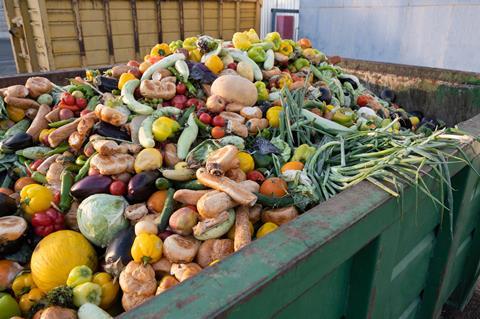
Food waste produces more GHG emissions than all international commercial flights, but still goes largely unnoticed and ignored in everyday conversations. People talk passionately about flying less or changing to a plant-based diet – so why isn’t food waste given the same attention?
This is particularly jarring when you think about the prominence of food in our daily lives and how much of our time revolves around planning, preparing and eating meals. After all, food production and consumption make up around 30% of global CO2 emissions.
Put simply, the UK cannot meet its net zero commitments without addressing food waste, and this requires the collaboration of the food industry. As one of the heaviest climate polluters, the sector should be doing everything it can to power change – something we at Wrap have been driving through the UK Food & Drink Pact and Food Waste Reduction Roadmap.
Since 2015, GHG emissions associated with UK food consumption fell by 14%. Progress is happening, but without the speed needed in areas with the highest opportunity. Actions to reduce the impact of food waste, agriculture and food packaging are lagging. Rapid acceleration is needed if we are to achieve the UK’s 2050 net zero goals.
Slow, uneven and off-track
One year on from launching the Net Zero Transition Plan, new evidence shows the pace of change remains slow, uneven and off-track.
Wrap’s latest report, focusing on the UK’s journey towards net zero from 2015 to 2023, highlights the following data:
- A 14% total reduction in emissions associated with UK food consumption, leaving a 36% gap to meet 2030 targets
- Over 75% of emissions come from food production, yet agricultural emissions have only fallen by 8%
- There has been a 52% reduction in emissions from household food storage and preparation but household food waste still generates 9.5% of food-related emissions, with six million tonnes of food being wasted every year
- A 49% reduction in emissions from food retail energy, but a 13% increase in emissions from food packaging.
Our food system is facing a range of headwinds and tailwinds such as weight-loss jabs, artificial intelligence and the threat of biodiversity collapse. These should not be seen as distractions from net zero: they are reasons to act.
Driving progress
There are four critical areas where the food sector can drive progress. Firstly, although more than 75% of UK food consumption emissions come from food production, there has only been a 6% decrease in food production emissions since 2015.
Data is key: more reliable and accessible environmental data will enable businesses from farm to fork to make evidence-based decision-making. This is the intention of Wrap’s LED 4 Food programme, funded by Defra.
Secondly, despite improvements, 9.5% of food-related emissions come from household food waste, and there are still six million tonnes being wasted in UK homes every year. Through the UK Food & Drink Pact, Wrap is uniting businesses, aiming to halve household food waste and its climate impact by 2030.
Next, the 13% increase in emissions from food packaging must be tackled. Businesses which have joined the UK Packaging Pact will be working to roll out smarter packaging design and reuse systems. There has been a 20% reduction in GHG emissions so far, but more effort is needed to bring down the total one billion tonnes of global CO2e emissions from food packaging.
Finally, we need to focus on evidence-based decision-making. Standardised, accurate emissions data is the foundation for sustainable, resilient food production. Without it, businesses cannot fully understand where their emissions come from, evaluate their performance, fairly benchmark suppliers, or have confidence that their actions and investments are the right ones.
Wrap is working to improve this too, focusing on the standardisation of data formats, developing consistent measurement frameworks and setting out clear Scope 3 protocols. Businesses in the UK Food & Drink Pact are actively helping to shape these essential resources.
Working together
No single company or segment of the food industry can achieve the change our system needs alone – we must move holistically. Collective action is already working, but it needs to be magnified.
Wrap is calling on food and drink businesses to reduce food system emissions by:
- Joining 200 other organisations in the UK Food & Drink Pact to act on household food waste, standardise farm and product data, and push more sustainable agriculture
- Signing up to the UK Packaging Pact to transform materials and reuse in food packaging, which launches in April
- Making healthier, plant-rich diets the easier, more affordable choice for consumers, by reviewing your organisation against the IGD’s Framework for population diet change.
We won’t reach net zero, and ultimately fix climate change, if we don’t tackle the emissions from food.
Estelle Herszenhorn is director of food system transformation at Wrap





No comments yet