



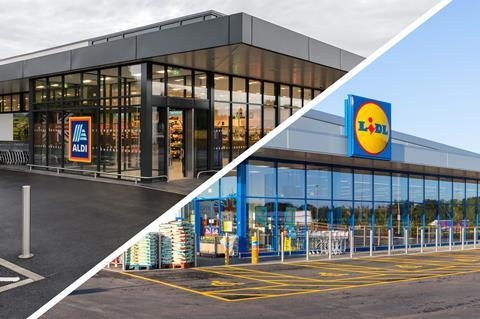
The Competition & Markets Authority has launched a consultation on whether to ban Aldi and Lidl from having clauses in property deals that block competitors from opening nearby.
Rivals Tesco, Sainsbury’s, Morrisons, Asda, Waitrose, Marks & Spencer and Co-op are already banned from having so-called restrictive covenants in new property deals, under the 2010 Controlled Land Order.
But Aldi and Lidl are exempt because they were not considered large grocery retailers at that time.
The consultation announced today follows a review launched by the CMA last year in response to concerns raised by traditional supermarket bosses of an uneven playing field.
The consultation is “seeking views on whether Aldi and/or Lidl meet the criteria to be designated as a large grocery retailer under the Groceries Market Investigation (Controlled Land) Order 2010”.
“When the order was made, seven large supermarkets were formally designated as large grocery retailers and required to comply with its terms,” the consultation document says.
“They were designated as large grocery retailers on the basis that they operate larger grocery stores throughout Great Britain or Northern Ireland or both or in a considerable part of the UK; offer for retail sale a full range of groceries; and maintain an integrated grocery wholesaling function that procures products directly from grocery suppliers.
“Aldi and Lidl were not at that time designated as large grocery retailers. They were instead considered to be limited assortment discounters, reflecting their more limited product ranges and low-price business model.”
It adds: “We are now considering whether Aldi and/or Lidl satisfy the criteria for designation in the order. As part of this work, we have already gathered evidence from Aldi and Lidl, and intend to gather further evidence from them and large grocery retailers.”
The consultation is particularly interested in views on whether Aldi and Lidl continue to offer a range of groceries significantly more limited than those of large grocery retailers covered by the order.
It asks: “What do you consider to constitute a full range of groceries? Do you consider that Aldi or Lidl stock a full range of groceries?”
It also asks if there has been or could be an impact on competition or to consumers from Aldi and Lidl remaining outside the scope of the order.
“We are particularly interested to hear of any examples where retailers have been unable to open a grocery store because Aldi or Lidl are not designated under the order,” it says.
The CMA wants to hear from from grocery retailers, relevant trade associations, consumer-focused organisations and industry bodies. Interested stakeholders have until 13 April to respond.
Read more: Aldi app change lets users see ‘range and pricing specifically for their store’
Aldi and Lidl sold between 1,000 and 1,400 products each when the order was drawn up. They are now estimated to sell about 1,800 and up to 2,300 respectively, with seasonal variation
The two discounters were approached for comment.
Since 2020, the CMA has named and shamed Tesco, Sainsbury’s, Asda, Morrisons, Co-op, M&S and Waitrose for breaching the order with land deals containing restrictive covenants.
Iceland chairman Richard Walker has been critical of Aldi and Lidl’s exemption from the order, though Iceland itself is also exempt. In January he accused the CMA of giving Aldi and Lidl a “free pass” by delaying the outcome of its review.
Aldi said at the time that it remained a limited assortment discounter, as defined in the order, and this meant it sold the same limited core range in all stores. It said it therefore had a different operating model to other, larger supermarkets, which sold significantly more products.






No comments yet