





The Co-op Group has taken a battering, while a recent merger has created the UK’s biggest independent society. What does this say about the 182-year-old co-op movement and its future in UK retail?
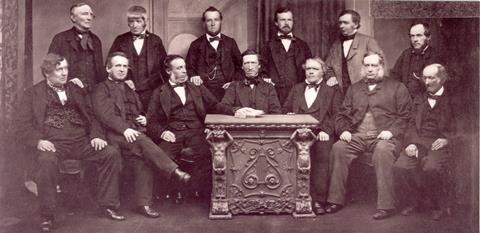
In 1844, a group of 28 working-class men in Rochdale set out a bold idea: a business owned by its members for mutual benefit. Fed up with expensive, poor-quality goods, they raised funds to open a shop built on quality, fairness and democratic control. It would become the blueprint for today’s co-operative movement.
The ‘Rochdale Pioneers’ venture inspired a global movement. There are now an estimated three million co-ops, with the top 300 alone contributing $2.8 trillion in sales. And in the UK, co-ops are worth £179.2bn, spanning more than 10,000 enterprises, 65.7 million memberships and 1.5 million jobs.
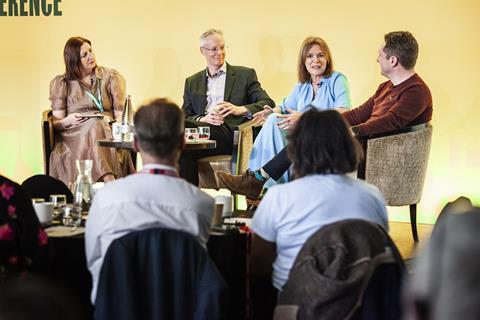
But success hasn’t shielded The Co-op movement from criticism, according to Co-operatives UK CEO Rose Marley. “When a plc fails, the story is usually bad management or a tough sector,” she said at the Co-op Retail Conference 2026 in Glasgow last month. “When a co-operative faces trouble, too often it’s the business model that gets blamed.”
Given another crisis at the Co-op Group – the UK’s largest retail co-operative, and the one most people call to mind when they think of ‘the Co-op’ – such questions are rearing their heads again. But are those doubts fair? How resilient are the societies? How is the co-operative movement changing in the UK to remain successful?
The speed with which the co-operative model gets blamed when things get tricky seems to stem from the distinctive way co-ops are governed.
“A co-op is owned by its customers, usually hundreds of thousands or even millions of them in some cases,” says former Co-operatives UK COO Neil Turton. “The board is made up of elected representatives of those customers, which is designed to provide a good cross-section of the public, especially for regional societies. This is very different to a plc listed on the stock exchange, where investment funds may own the majority of the shares and the board consists of professional executives.”
Businesses owned and controlled by their members? Each of whom has a vote to elect who sits on the board? Profits shared with the people who have a say and stake rather than distant investors or shareholders? Marley admits such a structure is unusual in a “capitalist society” and often misunderstood.
“You’ll be able to find a direct route from the people that use the business to the board, and there can be quite an elitist view that means board members might not be as skilled as they need to be,” she says. “It’s fear of the unknown. In any co-operative, it’s about making as much impact as possible for your members.”
It doesn’t always help that co-ops have traditionally been slower at reacting to market conditions, Turton says, due to the fact their governance structure is focused on “long-term stewardship” rather than profit targets or private equity needs.
“A co-op board is made up of people elected from the customer base who are usually not professional business executives,” he says. “The board doesn’t have accountability to the stock market or external stakeholders – it relies on having a good CEO and management to make things happen.”
In its simplest form, every co-operative revolves around fairness, democracy and solidarity. These principles, which have been formally adopted by the International Co-operative Alliance, run like a “golden thread” through the movement, says Marley. “All co-operatives share their power and wealth.”
That doesn’t make them immune to today’s economic pressures, though. Like any other retailer, the societies have grappled with rising crime, soaring operating costs and immense competition from supermarkets.
‘Action, not talk’
One way they’re adapting is through mergers. The recent merger between Central Co-op and Midcounties Co-op has created the UK’s biggest independent regional society, OurCoop. Turton sees the move as a turning point. “I’m overwhelmingly positive about it, because it’s action, not talk,” he says. “It’s a realisation in the retail co-op movement that it needs to go harder and faster to compete.”
The latest consolidation is far from unprecedented, though. In the 1900s, many of the then 1,400 independent co‑op societies began to combine. The dominance of the Co-op Group was established in 2000 when the Co-operative Wholesale Society and Co-operative Retail Services merged, and cemented further when United Co-operatives was folded into the group in 2007.
But other societies also merged at a rate of roughly one per year, culminating with Wooldale Co-op’s integration into Central England Co-op in 2017 (which later rebranded to Central Co-op). After that, there was a long pause until last year’s merger of Chelmsford Star Co-op with Central Co-op, followed by the latest consolidation that created OurCoop.
OurCoop’s motive to merge was “simple pragmatism”, according to CEO Debbie Robinson, formerly Central Co-op CEO. “It was about three fantastic co-op societies coming together whose leaders had a bigger picture and went beyond self-interest,” she says.
“The essence of it is how we better co-operate for the success of the movement in the long term, with democratic ownership at its heart. All three societies could have remained independent, but by bringing them together we can reduce costs materially, offer better value for members and reward our colleagues.”
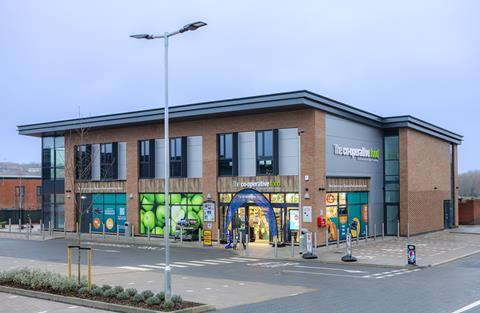
The enlarged society now serves over one million members, has 13,000 colleagues nationwide and unites more than 500 food stores with co-operative businesses in childcare, funeralcare, travel, energy and broadband. The ability to combine these specialist services was considered a major advantage of the merger. Midcounties Co-op had already acquired Central Co-op’s travel business in 2020, and Central Co-op acquired Midcounties’ funeral business shortly after in 2021. They have since “grown exponentially”, according to Robinson, driven by greater scale and investment capability. Bringing these services together under OurCoop creates an opportunity to reach more members, improve efficiency and benefit from shared infrastructure.
Boosting economies of scale from a buying perspective was also high on the agenda. OurCoop is now exploring opportunities with European suppliers through collaboration with EuroCoop for products such as tinned tomatoes, citrus fruits and bananas.
It’s also focused on enhancing its local proposition and bringing new products to market in emerging categories such as health, wellbeing and protein, as it looks to position itself as an innovative retailer. “The focus is on co-op to co-op collaboration, strengthening relationships with co-operative producers and improving value for members,” says Robinson.
What the merger won’t change is OurCoop’s existing supply arrangements with Federal Retail Trading Services (FRTS), the buying group for the UK’s retail co‑op societies, managed by the Co-op Group. Twelve societies buy through FRTS, allowing them to pool their collective buying power to negotiate better prices for nearly 4,000 co-operative food stores. About 90% of the regional societies’ food and drink is supplied by Co-op via FRTS, but they still have the flexibility to tailor ranges locally.
“If we want our confectionery planogram to look different to the way the Co-op wants theirs to be, that’s no problem,” says Heart of England Co-op CEO Steve Browne. “You want to get your ranging assortment down to a micro-local level and tailor it to what’s required in your community, as opposed to an area 200 miles away. FRTS is the cake and we add the sprinkles in terms of our own strategy.”
Vulnerable supply chain
As societies switched to the Co-op Group’s central supply chain the aim was to improve price competitiveness and availability, but three potentially existential crises at the Co-op Grop in the past decade – culminating in last year’s cyberattack – have underlined how vulnerable the movement is to its continued success.
“The independent societies are almost totally dependent on Co-op Group for their supply of products, because they’ve been encouraged to close their RDCs over the years,” says one industry source.
So when the Co-op Group was forced to temporarily shut down its IT systems in the wake of the attack, the availability issues affecting its own estate had a knock-on impact for independent societies. In fact, FRTS revenue dropped by 5.4% to £2bn last year thanks to disrupted supply. And with the Group’s membership data breached during the attack, other societies also had to reassure their own customers that their data was safe, despite their systems being entirely separate.
“The attack certainly didn’t help anybody,” says Browne. “It left a big hole in the way we were all operating at that point, and it was very much a hand-to-mouth situation for weeks. If things are going well and volume is good, we all get the benefit. But if things aren’t going so well, then we all feel the pain of it.”
The anonymous source also highlighted cultural tensions within the Co-op Group as a concern. Earlier this year, a letter to board members described a “toxic” culture at the top of the group, with “fear and alienation” among staff who felt unable to speak up in front of the leadership team, including CEO Shirine Khoury‑Haq .
“The cultural issues at Co-op Group recently seem at odds with the co-op movement’s values, which the societies pride themselves on, and understandably that makes them more than a little nervous,” the source adds.
It’s also important because the societies place a strong emphasis on their autonomy.
As Turton puts it: “Some people may ask: why is there just not one co-op? Why is there Co-op Group plus these regional societies? Societies’ product supply, including own brand, is dependent on Co-op Group. So the regional societies tend to express their ‘co-op-ness’ at a much more local level through their community involvement and retailing personalities.”
‘The changing nature of the economy’
That autonomy, however, sits within an increasingly challenging retail environment. “We are staunchly independent,” says Browne. “But we also have to be realistic about the changing nature of the economy.
“Co-ops have always been good neighbours and cared about their community, the planet and being good employers. But they’re all very difficult things to do when the economic elements of navigating the territory of convenience is so high.”
More on the Co-op:
-
The next Co-op CEO must be a retailer – but it’s not Gottschlich
-
Co-op CEO Shirine Khoury-Haq insists exit unrelated to ‘toxic’ culture claims
-
Co-op plunges to loss after cyberattack as CEO steps aside
-
Enterprise Foods’ sudden collapse forces Co-op to step in with supplier support
He points to various shifts in consumer behaviour that are affecting trade, such as declining tobacco sales, the rise of GLP-1 weight-loss drugs and a growing number of adults choosing not to drink alcohol.
But Browne is optimistic. “We might not be able to replace all of the sales, but we can replace the profit,” he says. For Heart of England Co-op, foodservice is a key growth opportunity. “It’s about being creative in food to go and going beyond sausage rolls and bacon sandwiches – it has to be broader than that,” he says. The society is set to launch a “food destination store” in July, primarily focused on food to go with a smaller grocery offer. “It’s a complete switch,” Browne adds.
It’s also focusing on health and wellbeing categories, protein snacking and meal-for-tonight solutions, alongside gifting. “I don’t think there’s one single silver bullet in this marketplace now – it’s about being 1% everywhere,” Browne adds.
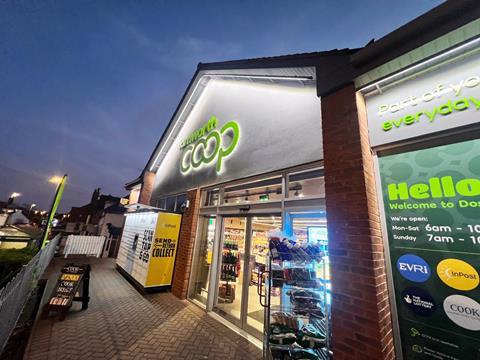
Tamworth Co-op is also sharpening its focus on food to go. It relaunched its Dosthill store in December, putting the mission front and centre with new refrigeration and dedicated space. The society is also capitalising on AI through intelligent markdown and waste‑management technology. It plans to roll out electronic shelf labels across all stores in the coming months and is developing a new member app.
“As long as we continue to recognise these shifts and invest in our stores accordingly, focusing on areas that offer more sustainable growth, we will retain our presence over the longer term,” says Tamworth Co-op CEO Dan Welsh.
Collaboration without the Co-op
There are also initiatives that other societies besides the Co-op Group can lead on, through the co-operative’s core principle of solidarity. One key example is corporate power purchase agreements (CPPA), which sees co-op societies come together to increase buying power and sign joint agreements with energy providers.
Last year, what was then Central Co-op led on a 10-year CPPA with energy company RWE on behalf of five independent societies: Lincolnshire Co-op; Scotmid; East of England Co-op; Southern Co-op; and the former Central Co-op. The agreement supplies renewable electricity to over 400 co-operative locations across the UK, allowing the participating societies to benefit from lower costs, reduced risk and improved sustainability outcomes.
With solar installations expanding across OurCoop’s estate and the power purchase agreement in place, green energy is contributing around 22% of OurCoop’s energy use. And it’s not just energy. Since early 2026, the societies have also worked together in areas such as water, refrigeration, facilities management, cash management and technology. In total, 25 collaborative projects have delivered £29m in savings.
So, regional societies appear to be navigating a challenging convenience economy. And they’re confident the movement still stands up.
“The co-operative model has proven resilient over many decades, and its focus on member ownership and community benefit continues to resonate strongly today,” says Scotmid Co-op CEO Karen Scott.
“Different societies take different approaches depending on their geography, strategy and member priorities. The diversity of the movement, with large societies, strong regional co-operatives and community co-ops, is one of its strengths. At a time when people increasingly want businesses to act responsibly and invest locally, the co-operative model remains highly relevant.”
Browne agrees the movement is still resilient, and points to the advantage of financial stability. “We’re not coming off the back of being heavily leveraged unlike some PLCs – we have no bank borrowing,” he says. “But on the flip side, you can’t be as agile when trying to buy property because you’ve got to be careful about how you use your cash resources. We know we’re in territories where people want and will always need us, but how they need us is changing.”
Turton also believes the fundamentals are strong. “The retail co-op movement is resilient, because the remaining societies such as Lincolnshire and Scotmid are well financed and have built strong balance sheets over many years,” he says. “They’re not under existential threat – they’re strong businesses.”
The real challenge is how quickly the societies can adapt to an evolving convenience market while staying true to the movement’s founding principles. That’s the difficult balance the co-ops must strike.
For OurCoop’s Robinson, the answer lies in collaboration at scale. “The co-operative movement is already global,” she says. “The moves towards closer alliances with European co-ops and co-ops on a global scale is something we can do that the competition can’t. That’s going to give us resilience, backed by smaller local producers that enhance the local economies where our stores are – and that’s the virtuous circle of co-operation.”
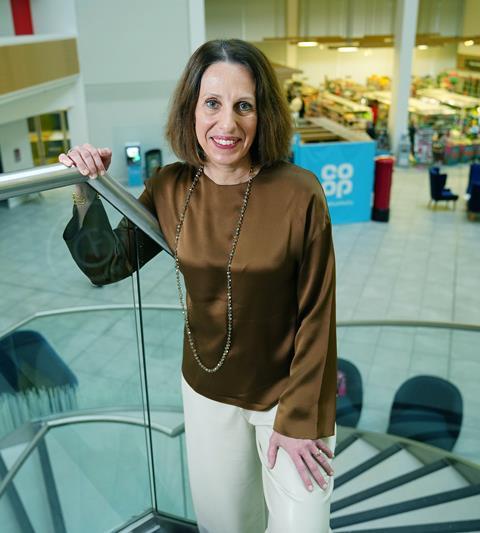
Analysis: Co-op Group’s results for 2025
Last week, Co-op Group revealed its results for the year to 31 December.
These were always expected to be a challenging set of numbers, as they covered a tumultuous year during which the society was hit by a cyberattack. That incident not only had a massive and predictably negative impact on sales and profits. The longer-term implications of the attack also seemed to sow the seeds of discontent and division among the Co-op leadership, though CEO Shirine Khoury-Haq denied that media reports of a ‘toxic culture’ had led to her departure at the start of this week.
As well as wiping more than £100m off the Co-op Group’s profits and well over £250m off its sales the results were also notable for a big increase in net debt, which shot up to £317m from £55m. While this is nowhere near the perilous levels in 2022 (nearly £1bn) that Khoury-Haq did so well to pay down, it’s still a big jump, and while this was linked to investment in a new growth strategy, the Co-op also pledged to slash £200m of operating costs in 2026.
And while bad, last week’s results do not come with anywhere near the existential threats seen previously, either with the incredible debt levels the Co-op racked up before Khoury-Haq’s intervention in 2022 or the crisis in 2013 following the discovery of a £1.5bn black hole in the finances of The Co-operative Bank in 2013.
In fact, the £107m impact of the cyberattack – which contributed to the swing from a £131m underlying operating profit to a loss of £35m – was not as bad as the original H1 estimate of £120m. And just as significant was the extra £150m in employee and other taxes.
Still the attack wiped £285m off Co-op sales after it was forced to shut down its systems in response. Total sales fell 2.3% to £11bn and Co-op said this would have been a 0.3% uptick were it not for the cyberattack. Sales at its food business were worst affected, down 2% to £7.3bn. The Co-op said sales would have been up 1% without the attack.
Even worse was the impact on the wider Co-op family, however: sales in the Co-op’s Federal Retail Trading Services division, which supplies other regional co-op societies, fell 5.4%, again linked to the cyberattack.
Nonetheless, the Co-op looks set to plough ahead with its strategy of creating a new group commercial and logistics division to help grow sales.
So it will be imperative that while Khoury-Haq was “increasingly confident we can create the UK’s second-largest buying group”, those left to implement the strategy after her departure will need to figure out how to make sure that if the Co-op catches a cold, the rest of the co-op family does not catch flu.








No comments yet