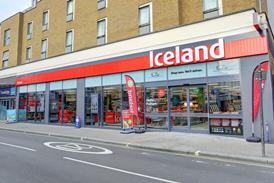
Iceland store

Source: Iceland

Iceland’s operations have the highest greenhouse gas emissions relative to sales, according to The Grocer’s analysis of supermarkets’ latest climate disclosures.

Iceland emitted the equivalent of 157,808 tonnes of CO2 (tCO2e) from its own operations in the year to 31 March 2025, equating to a carbon intensity of 38.33 tCO2e per million of sales.

Iceland’s carbon intensity is more than three times that of Aldi 10.56 and Lidl 11.02.

In absolute terms, the highest emissions came from Tesco, with 1.38 million tCO2e in its latest report. With £63.64bn in sales in the 2024/25 financial year, its carbon intensity is 21.76 tCO2e per million of sales.


Large companies are required to disclose greenhouse gas emissions for their own operations, such as their own fleet and refrigerants, and indirectly from the generation of purchased energy known as Scope 1 and Scope 2 under Streamlined Energy & Carbon Reporting (SECR) regulations. Reporting of Scope 3, which covers the entire value chain including suppliers, is currently voluntary.

Iceland declined to comment specifically on The Grocer’s findings, but pointed to a number of measures it has taken to reduce its emissions. “We have an ongoing asset upgrade programme, replacing thousands of our older freezers with new, more efficient versions,” a spokesman said. “Not only do the new freezers use natural refrigerants wherever possible, they are also more energy-efficient. On average, stores refitted with new freezers consume 30% less energy than stores using older equipment.”

Iceland is also one of three global retail members of the Move to Minus 15°C coalition, an initiative dedicated to cutting carbon emissions in the frozen food supply chain by shifting temperature standards from –18°C to –15°C and is completing trials to assess viable changes.

He added that Iceland now received 14% (14,300 tCO2e) of its annual electricity through a large off-site solar farm through a Power Purchase Agreement.

It has also installed solar panels in one distribution centre and 20 stores, and  plans to install solar panels at a further 96 sites by March 2026, while chiller doors have been rolled out across fridges in its Food Warehouse shops.

No update was provided about its fleet’s use of diesel, save for plans to grow its electric home delivery fleet to 11 vans in 2024.

Iceland has previously stepped back from environmental commitments . In 2022, it abandoned a high-profile pledge made in 2018 to remove plastic from all own label packaging by 2023, claiming it had become “impossible” to do so without passing on some of the cost to consumers, which it was not prepared to do during a cost of living crisis.

In last year’s carbon report, Iceland also said it would no longer report market-based emissions under Scope 2 reports, which give credit for buying certified renewable energy within energy purchasing agreements. “As has been well publicised, the energy market including UK grid emissions has dramatically changed in the last 18 months and access to REGOs [Renewable Energy Guarantee of Origin certificates] have been severely impacted,” it said at the time.

However, 100% of electricity purchased by supermarkets including Aldi, Lidl, Tesco and Sainsbury’s is certified as renewable.

Aldi: top performer

Aldi, the best performer, detailed that it had installed solar panels at over 440 of its stores and across 11 UK regional distribution centres, and was assessing opportunities for further solar panel installation. In 2024, Aldi UK continued to replace the use of diesel in HGVs with alternative fuels such as hydrotreated vegetable oil (HVO) and bio-compressed natural gas (Bio-CNG). These reduce carbon emissions compared with diesel by up to 90% and 80% respectively and decreased diesel consumption in Aldi’s UK own fleet by 19.8%.

Aldi reduced its carbon intensity by 6.4% year on year. Aldi’s Scope 1 and 2 emissions reduced by 4.3% or 11.3% when certified purchase of renewable energy is accounted for.

Liz Fox, national sustainability director at Aldi UK, said: “We put sustainability at the heart of everything we do. It matters to us, and we know it matters to our customers.

“We are always looking for new ways to minimise our carbon footprint, and our uniquely efficient business model is one of the reasons we are able to reduce emissions and pass savings on to customers. We have made strong progress in addressing our operational greenhouse gas emissions in recent years, and we’ll continue to work with our suppliers and partners across the supply chain to find innovative ways to drive further reductions.”

Scott Poynton, co-founder and CEO of Earthtrust, an environmental data transparency and verification platform, and author of Beyond Certification, said:

“It’s no surprise to see Aldi and Lidl doing the best because they count the coins the most. They might have an initial outlay on expenditures on electric fleet or solar panel installation, but these people are experts at doing the numbers and working out what investment will save them in the long run.

“Sometimes announcements on single measures are more designed to grab headlines than to drive change. The best performers tend to demonstrate improvement through quiet, industrial commitment to multiple initiatives. 

“Clever companies understand that sustainability can have a positive impact on the bottom line: if you care about the climate and you’re saving money then keep doing it.”

Poynton called for greater transparency and proof points in retailers’ sustainability reports.

“Progress is really hard to compare and this leads to an erosion of public trust and accusations of greenwashing. It’s 2025! Don’t tell people you’re ‘working on the decarbonisation of your transport fleet’. Share the data transparently and let the world decide if you’re walking the talk.”

In total, the eight supermarkets analysed emitted the equivalent of 3,701,846 tonnes of carbon dioxide, according to their latest disclosures – the same as four million flights from London to New York.