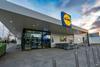
Lidl has sailed past Morrisons in market share, comfortably securing its position as the UK’s fifth biggest supermarket.
Lidl accounted for 8.6% of the UK grocery market in the 12 weeks to 17 May, according to new Worldpanel by Numerator data, up from 8.1% a year earlier, as its sales grew by 8.8%. At the same time, Morrisons’ market share dropped from 8.4% to 8.3%, as its sales climbed only 1.3% year on year.
It is the first time Lidl has pulled ahead of Morrisons, following two consecutive months in which it has matched the supermarket in market share.
It is also Lidl’s 35th month in a row as the UK’s fastest-growing bricks & mortar grocer, beaten only in Worldpanel’s analysis by Ocado. The online supermarket’s sales were up 10.2% year on year in the latest period, pushing its share from 2% to 2.1%.
Lidl was also outpaced by M&S, whose grocery sales were up 9.3% over the 12 weeks. Worldpanel does not recognise M&S as a grocer in its methodology thanks to its clothing & home sales, and does not allocate a share figure to the retailer. However, M&S CEO Stuart Machin disclosed last week that its grocery market share had reached 4.1%, or 4.6% with online sales through Ocado included.
Lidl’s sales have been boosted in recent years by its loyalty scheme, Lidl Plus, with about half its growth in its last financial year coming through customers increasingly using the app, and the other half through switching from rivals. Lidl chief customer officer Louise Weise recently told The Grocer growth was coming from “people buying into new categories, new products, switching to a main shop mission with Lidl, which is something we’re really, really proud of”.
Lidl has added nearly three percentage points to its market share since the app was launched in 2020.
Tesco was the second fastest-growing bricks & mortar supermarket in Worldpanel’s latest market update, with sales up 3.2% year on year, pushing its market share from 27.9% to 28.2%.
Aldi grew sales by just 0.6% year on year, and its market share dropped from 11% to 10.8%, indicating sales fell on a like-for-like basis. The market share gap between Lidl and Aldi has closed in the past two years from 3.1 to 2.2 percentage points.

It was another poor showing for Asda, whose sales were down 0.3% year on year, leading its market share to fall from 12.1% to 11.5%. The supermarket last week announced changes in stores including a revamp of fruit & veg and “clearer” signage, plus a new round of price cuts, to lure shoppers back.
Co-op was the only other major grocer whose sales fell, by 0.1% year on year, taking its market share from 5.2% to 5.1%.
Grocery price inflation in the four weeks to 17 May was 3.1%, its lowest rate since December 2024, while total take home grocery sales rose by 1.5% as shoppers leaned into promotions, according to Worldpanel. Nearly a third (30.3%) of sales included a deal, up from 28.4% a year earlier. Spending on promoted items rose by 9.5% year on year, while full price spending grew by just 0.1%.
“The easing in the rate of inflation is welcome news for shoppers who have been grappling with warnings of a hike in food Prices due to the impact of the war in the Middle East,” said Fraser McKevitt, Worldpanel head of retail and consumer insight.
“This follows the UK government’s announcement of a plan to further reduce import tariffs by £150 million on a range of food categories. While further details are expected this week, this would equate to just £5 per household, with the average annual shopping bill for food and drink, excluding alcohol, totalling £4,087.”
A grey early May bank holiday impacted sales of summer essentials such as suncare and ice cream, which were down in volume by 28% and 3% respectively. Meanwhile, sales of soups, fresh pies and coffee rose by 9%, 4% and 5% respectively.
McKevitt added: “May was a tale of two bank holidays. The cool start kept summer categories in the shade, with unseasonable weather hanging on longer than expected. But with record temperatures over the second bank holiday, we expect to see a significant uplift in spending on summer essentials like BBQ, suncare and ice cream as the month comes to a close.”
Separate grocery sales data from NIQ, also released today, shows Morrisons still ahead of Lidl in the 12 weeks to 16 May, with 8.5% of the market versus 8.3%.

NIQ gives M&S a market share of 4.1%, up from 3.8% a year earlier. Its sales rose by 11.8% year on year, making it the fastest-growing bricks & mortar grocer in NIQ’s analysis. M&S is also comfortably ahead of Waitrose, which has 3.8% of the market.
Total Till sales at UK supermarkets were up by 4.2% in the four weeks ending 16 May, helped by the comparison with a weaker period after Easter last year, according to NIQ.
NIQ said growth slowed over the final three of the four weeks, reflecting cost of living concerns.
The cost of the average basket was up by 3.8% year on year to £20.23.
“After weak growth in the first two weeks of May, sales are no doubt going to pick up again as a result of the current heatwave and a sustained period of warm and sunny weather should now maintain this momentum through June,” said Mike Watkins, NIQ head of retailer and business insight.
“The next six weeks to the start of the school holidays are always a good ‘trade up’ opportunity for retailers, with seasonal, fresh and ‘al fresco’ dining also top of mind for shoppers. Additionally, the imminent start of the FIFA 2026 World Cup will bring some attractive promotional offers for shoppers which will encourage them to spend.”
Watkins said the World Cup would also provide a boost to rapid delivery and convenience stores, which had so far underperformed in 2026.
“Shoppers may also look again at the convenience of online shopping, and some will be inclined to spend more on ‘dine in at home’ offers rather than eating out,” he added.


No comments yet