





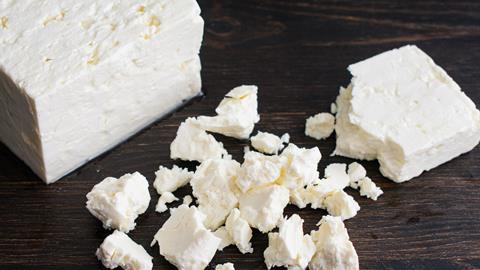
As if the US didn’t have enough on its plate, the global superpower has now taken a swipe at feta’s Protected Designation of Origin (PDO).
The US trade representative took to X earlier this week to complain the Greek cheese’s protection “locks American producers out of key markets merely for using certain cheese terms”.
But at a time when diplomatic bridges are being carefully tended – including during King Charles III’s current triumphant visit across the pond – it is hard to see how such comments help smooth US‑EU relations. Whatever the intention, this was another shot that missed its mark.
It’s all Greek to me
The comments first appeared in a muddled thread on social media platform X, listing what the department described as the “craziest foreign trade barriers facing American exporters”.
Alongside feta, the list also included Costa Rican bean inspections, Nigerian bans on some American beef categories and Japan’s failure to impose restrictions on Russian seafood imports.
“Within the European Union, the term ‘feta’ can only be used for cheese produced in Greece, since the EU claims that certain cheese terms are connected to specific places in Europe,” asserted Jamieson Greer, AKA the “quiet architect of Trump’s trade war”.
“However, there is no specific place named ‘feta’ in Europe! And the EU forces other countries to follow this same nonsensical rule.”
Despite the bombast, there is an argument to be had. In taking a legal cookie cutter to foods, protections like PDOs can be accused of flattening diversity and elevating strict national narratives over other, messier culinary histories.
The European Commission’s own page on feta traces the name back to the 17th century, with evidence of a primitive form being mentioned in Homer’s Odyssey. Yet the Greek version only came into being in the 19th century, with formal steps to codify ‘feta’ production beginning in the 1930s.
Nor was the PDO granted in 2002 without controversy. Denmark, Germany and France all challenged it along the way, and in 2022 Denmark was successfully sued for failing to stop cheese producers from using the term ‘feta’ to describe cheese exported outside the EU.
Though imperfect, the attempt to protect heritage through PDOs is admirable and, if issues with counterfeit parmesan are anything to go by, there is value in setting some boundaries in law.
The bourbon countershot
In the current geopolitical climate, frustrations with cheese terms are unlikely to be front of mind for most Americans. If Greer really wants to rant about “the craziest foreign trade barriers”, perhaps he should look a little closer to home.
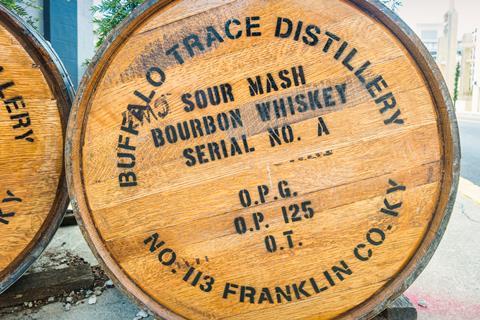
The criticism of feta’s PDO from his department is, however, particularly bizarre, given that the US government is guilty of exactly the same sin when it comes to regulating bourbon.
Under US law, “the word ‘bourbon’ may not be used to describe any whisky or whisky-based distilled spirit not distilled and aged in the United States”. It does not take a legal expert to spot there is no reference to a place named ‘bourbon’. For that matter, no one can even agree from where the name originates.
Even if a producer elsewhere in the world followed exactly the same methods as set out in US law, their whisky could never be called bourbon unless it was solely created on American soil.
The feta trade-off
Feta accounts for roughly 10% of Greece’s €9bn (£7.8bn) food exports, according to the European Commission, so it is understandable that American producers should want a slice of the household name.
However, the sums involved are worth about as much as Kentucky’s $9bn (£6.7bn) whiskey and bourbon business alone. American producers would hardly welcome exposure to additional competition from Irish, Scottish or Japanese imports.
E&J Gallo Winery acquired Japanese conglomerate Kirin’s Kentucky-based bourbon supplier Four Roses Distillery $775m (£570m) in February, underscoring how lucrative bourbon can be.
With neither the US nor the EU likely to budge on their respective protections, there seems to be little if any reason to pursue the point.
If the US continues to do so, it might first consider the state of its own house before casting any more stones.










No comments yet