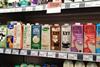
Dairy alternatives

The UK Supreme Court’s recent ruling that Oatly can no longer trademark or use the slogan ‘Post Milk Generation’ generated a flurry of headlines. What it didn’t generate is clarity, either for consumers (who are not confused) or for plant-based manufacturers, who haven’t been able to market their products as ‘milk’ since a European Court of Justice ruling in 2017.

So why all the legal theatre now?

There is no credible evidence that shoppers are confusing cows milk with oat, almond or soy milks. Nor is anyone accidentally frying a vegan sausage when they meant to buy one made from pig flesh.

Yet the meat and dairy lobbies continue to insist that the courts arbitrate on the matter, all while gifting plant-based producers free publicity.

Why? They’re running scared. Dairy UK lawyered up against Oatly because they know consumer behaviour is changing. 

Changing diets

Recent Vegan Society research, for our Play Fair with Plant Milk campaign, showed that one-third (33%) of people in the UK drink plant-based milk regularly (either every day or a few times a week). Other figures show the global oat milk market is predicted to grow almost 14% per year over the next five years.

This is part of a bigger societal shift towards more compassionate and environmentally-friendly diets. Around two million people in Great Britain are now following a vegan or plant-based diet, around 10% don’t eat meat, and more than 30% are flexitarian (reducing meat consumption).

Meanwhile, dairy farmers poured away unwanted cows milk over Christmas 2025, as farmgate prices weakened by 5.3% in November and a further 6.1% in December. Too much supply or not enough demand?

And if demand is slipping, what happens to the cows whose milk is no longer wanted? Most people know the answer to that question, even if they don’t want to acknowledge it.

The wider landscape shows the meat lobby at work, successfully priming the European parliament to vote for a ban on using words such as ‘burger’ or ‘steak’ to describe plant-based variants. While this needs further EU approval, it’s illustrative of the power of the lobby, whose campaigns against vegan diets and alternative proteins – often dubbed as the ‘ultra-processed’, unhealthy options – are widespread and well funded.

These arguments are slipping into government policy in the UK. The Scottish government’s draft Climate Change Plan doesn’t contain any references to plant-based diets, despite expert advice from the Committee on Climate Change about the crucial role of a plant-based diet in reducing emissions.

Meanwhile, Quality Meat Scotland – a statutory body – has launched a toolkit singing the environmental praises of red meat, when the World Resources Institute, which receives UK government funding, has just affirmed that “the only way to guarantee you’re lowering the climate impact of your beef is to buy less of it”.

Honest conversations

And there we have the real confusion: not in the name of a veggie burger or an oat milk latte, but in a government food policy landscape that is contradictory and shaped by well-resourced lobbies intent on keeping the focus away from plant-based diets and the environmental cost of farming animals.

Consumers aren’t daft, but if lobbyists push hard enough, they distract everyone from the honest conversations we need to have about our unsustainable food system.

Ironically, all of this may be doing plant-based businesses and consumers more good than harm. Oatly’s PR team has had an enjoyable couple of weeks, and farmers and food producers may soon realise that they must follow the market, not lead their animals to it.


Claire Ogley is head of campaigns, policy and research at The Vegan Society