



Borough Broth is busy befriending beavers at its new HQ. It’s all part of a bigger plan to create a healthy £40m business
Beneath gun-metal skies and row after row of grey sheds on an industrial estate in West London, Borough Broth has officially opened its new factory. Signs for a residential development project dot the roadside and promise ‘canal-side calm’. It seems a stretch.
Yet, a stone’s throw away, wild beavers are happily building dams in Paradise Fields, a rewilded flood plain bordered by the Grand Union Canal. The ecosystem engineers were introduced to the area by the Ealing Beaver Project in 2023 to restore nature, boost biodiversity and offer winter flood protection for the surrounding town.
🔔 Get industry insight direct to your phone
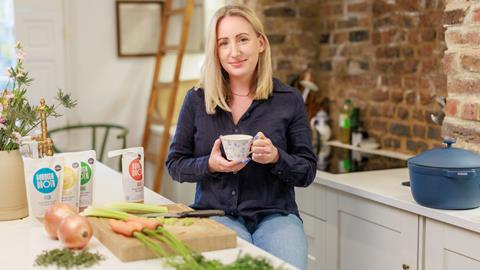
Borough Broth founder Ros Heathcote’s vision is for her 28,000 sq ft manufacturing plant and brand HQ to operate in harmony with the hidden oasis on the other side of spiked security fencing.
“We’ll have access to the canal path from the spring, and we plan to take the staff over to the beavers to understand the ecology of the area and formalise the education of why we’re proudly organic,” she says. “It’s a big part of who we are. We’ve got solar panels on the roof, a little bee hotel in our car park and we’re talking about getting beehives.”
Stepping into Borough’s reception, a comforting aroma of simmering bone broth envelops visitors in a soothing, meaty cuddle. “I do feel for our veggie staff,” Heathcote says.
The factory has been operational for just one week, and it’s all hands on deck to catch up after an enforced two-week production shutdown during the move from the brand’s old home just down the road, which Borough had long since outgrown. “Moving as the weather turned cold and demand for soups and stocks ramps up wasn’t ideal,” she drily observes. A half-price promotion at Waitrose didn’t help matters, but the brand is just about back on track when The Grocer visits.
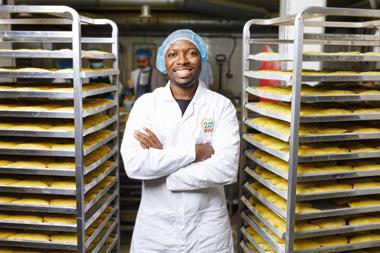
A team of 70 staff, across manufacturing, warehouse and back office, are busy finding their feet, and production is in full flow. Broth making is a messy and manual labour of love. One worker is up to his elbows in a vat of spent chicken carcasses and vegetables, the arms of his white overalls stained broth brown.
Name: Ros Heathcote
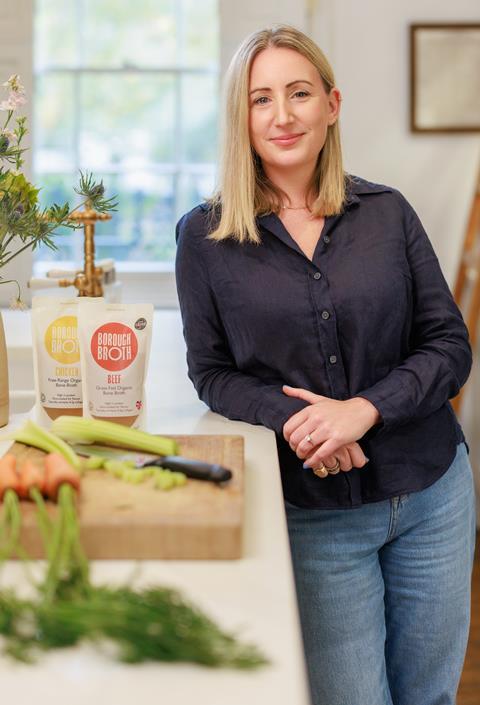
Born: Wimbledon
Lives: King’s Cross
Age: 42
Family: Marrying Borough marketing head Matt in three weeks
Potted CV: Early career in IT; eight years in software engineering; founded Borough Broth in 2015
Career highlight: Building our new factory from scratch
Business icon: Guy Singh-Watson
Business motto: Do things the right way
Item you couldn’t live without: My water bottle
Hobbies: Painting and gardening
Favourite film: The Blues Brothers
Favourite book: Philip Pullman’s His Dark Materials trilogy
The move has doubled capacity to 28,000 pouches of broth a day and almost 3,000 tonnes of the stuff a year, with room for volumes to more than triple as demand rises. But scale and in-house manufacturing doesn’t come cheap. The build cost close to £5m, with Borough selling a minority stake to private equity firm Piper for £7.5m to resource the project.
“It is a massive overhead, and we’ve committed to a 10-year lease, so that’s the scary bit,” Heathcote says. “The good thing is, if it all went to shit, we could make any number of products in here for anyone. That’s the fallback, should we need it, but I’m certain we’re not going to.”
Despite all the bells and whistles of a people carrier-sized bone-roasting oven, a semi-automated waste removal system and giant blast chillers for rapidly cooling the finished product, Heathcote is sticking to her handcrafted artisan guns – just on a slightly bigger scale. Cooking continues in the 500-litre kettles the company has used for the past nine years, but now there are 30 of them. She insists there is no way to avoid diluting the flavour or quality if the vessels get any bigger. And she remains steadfast on continuing the low and slow 24-hour cook time for each batch.
“As we start to scale manufacturing, I realise how much I love having a factory, because you have complete control. And we can talk to our consumers about the fact we’re field to fork, literally.”
The hope is that improved economies of scale will eventually mean bringing the price of the broth down as well. “There’s always been resistance on the price from naysayers insisting no one would pay £5 or £6 for the product. I’m pleased to say we proved them wrong. But my goal is to make our products as accessible as possible while still having a viable, profitable business. It’s getting that balance right.
“I do think our price is still inaccessible to a number of people. But we’re a premium product, so we’re never going to be £2. And, actually, if you were to go out and buy an organic carcass from a butcher, organic vegetables and herbs, spring water, and slow cook it all at home, including the energy usage and the value of your time, it probably costs you a lot more to make the same amount.”
Despite the high-end price tag, bone broth is firmly part of mainstream grocery today, with Heathcote largely responsible for its rise. In some quarters she is known as the ‘founding broth lady’ given there was no category to speak of when she started in 2015.
Heathcote first became obsessed with bone broth to manage general poor health and allergies developed in her 30s. After visiting a specialist, she was advised improving her gut health could potentially build up immunity and resistance. A nutritionist recommended bone broth and Heathcote never looked back.
She started making it every day using surplus bones from a local butcher in Bermondsey and shortly after set up Shopify and Instagram accounts to sell chicken and beef broth online. Her day job in IT as a data analyst at Coca-Cola strangely inspired the end product Borough still makes today. “I filled a Coke can with broth and weighed it. I thought: ‘Oh, that’s the perfect size.’ It was 324g.”
A restorative product
Initially, most customers bought her wares for supposed health properties to help with digestive issues, inflammatory diseases or injury recovery. “We suddenly realised it was a restorative product for a lot of people,” she says.
Within just six months, Borough Broth launched in Selfridges. In 2018, Heathcote raised £125k from friends and family and went all-in to win the brand’s first major retail listing with Ocado. “Thankfully, we got it. It would have been a disaster otherwise. Then we just grew and grew.”
The brand has come a long way since its scrappy early days, but Heathcote says about 35% of customers still drink her broth for health reasons.
While there is no denying broth is a clean product when made simply with water, bones and veggies, there is little, if any, real evidence for it being a restorative elixir. Yet the category as a whole leans into these health claims, pushing a gut health narrative among other benefits. Does this approach risk misleading consumers?

“There’s always been resistance on the price from naysayers insisting no one would pay £5 or £6 for the product. I’m pleased we proved them wrong”
“Bone broth as a category can definitely be at risk of overpromising on the health,” she says. “We are very intentionally not focused on the health benefits. And that’s not because I don’t believe in them – I do – but because our whole ethos as a business is to be transparent and honest. That’s really key as a principle. I don’t want to take a study and push it. And that’s why we don’t call out the healthy claims on the pack, because it’s up to consumers to make that decision. The last thing I want to do is sell snake oil. We’re about being delicious.”
Health haloes aside, bone broth is increasingly big business, and the market grows more crowded by the day. Alongside the profusion of challenger brands selling broth across ambient and chilled, liquids and powders, the bigger corporates now want a ladle full of the action. Premier Foods unveiled a minimally processed carton under the Oxo brand in October 2025 at a competitive £3.50 for 500ml and, just this week, soup specialist Baxter’s launched 10-hour slow-cooked beef and chicken broths, charging £4.50 for a 300g ambient pouch.
Heathcote remains sanguine on the ever-more crowded category. “New entrants can only benefit and grow awareness,” she reckons.
Borough, for its part, continues to innovate, taking the natural step of using its broth to make chilled, ready-to-heat gravy pouches, which hit supermarket fridges in September. With a whole new factory and development kitchen to play with, there is endless room for further NPD.
Revenues at Borough hit around £15m in its latest financial year, with the long, hot summer curtailing demand a little. Longer-term ambitions should push the brand to closer to £40m by 2030. “I think we can do more, but we’re setting that as our goal for now. And by next year we should be profitable,” she says. “If the winters are cold, then we’re fine.”
For now, Heathcote is focused on bedding in the new manufacturing hub next to her beaver neighbours. “As a factory owner, it’s about making this an incredible place to work. That’s what gets me out of bed. And making products that are really nourishing people.”






No comments yet