


Asda was able to grow sales of ‘healthier’ products by almost 25% by subtly ‘nudging’ customers to switch to better baskets.
The supermarket has published the much-awaited results of its two-year partnership with the innovation body Nesta. The report offered “encouraging signs” for policy makers and supermarkets that it is possible to support customers to make healthier choices, in a way that is commercially sustainable, Asda said. It would still need to test the findings at scale, however.
Asda ran a series of small-scale trials in up to 20 of its stores, between October 2023 and March 2026.
It included boosting the prominence of healthier products in high footfall locations like store entrances and tills; giving increased space to HFSS-compliant products in freezers; grouping products by dedicated health mission with prominent health messages; as well as using vouchers as incentives for shoppers to buy fruit & veg.
Overall, six out of the eight trials delivered an uplift in sales of healthier products based on the government’s own NPM health score. The increases ranged between 10%-25% across the trials.
Asda would now use the findings to help shape its long-term health strategy, which aims to improve the average health score of its sales year on year to 2030. It has not revealed a specific target, however.
“We’re proud of the health strategy we’ve developed and the progress we’ve made as part of our work with Nesta,” said Darina Hall, Asda senior director for technical, quality & sustainable sourcing.
“These trials have shown what can work at a small scale, and our focus now is on evaluating how initiatives like these can be scaled, so we can better incentivise healthier choices and maximise the positive impact they can have on the nation’s health.”
Positioning of healthy products had a positive influence on sales
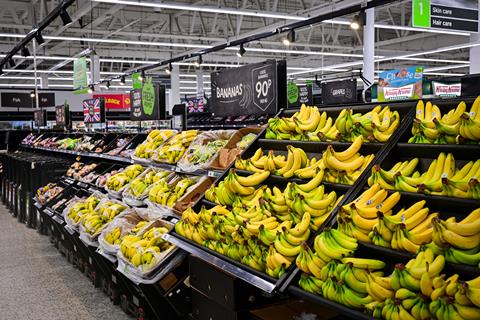
The trials focused on produce, snacking and frozen categories. Of the successful trials, the positioning of products was found to be the most effective.
Asda replaced products stocked in wire bins with ‘healthier’ snacking products like popcorn in 10 stores, and saw a 19.9% uplift in sales and 14% growth in unit sales of included lines.
In an additional seven stores, it began merchandising dried fruit and nuts by the checkouts, which delivered a 24.9% increase in sales, and 16% increase in units sold. Nuts tended to sell much better than fruit, however, which Asda said showed that product choice mattered as much as prominence.
In four stores, Asda placed healthier products by the entrances, which helped to deliver a 10.7% sales increase on included lines.
Merchandising trials proved to be less effective. Asda increased the number of shelf facings given to healthier lines of its own-label pizza. However, it saw no increase in sales.
Results of its messaging trials in snacking bays were more positive, albeit mixed. The trial grouped products in bays dedicated to specific health missions – low calorie and more fibre. They were accompanied by health messaging promoting ‘Less Than 100 Calories’ and ‘Source of Fibre’.
The former lifted sales by 6.8%, whilst notably, the latter led to a 7.8% decrease in sales on included lines, and 0.2% drop across the wider category.
For the final set of trials, Asda focused on incentives.
In five stores it gave Asda Pharmacy customers £5 vouchers to spend on produce. Only around 7% of vouchers were redeemed. In the majority of cases customers used them to buy products they were already intending to buy, rather than adding more fruit & veg to their baskets.
Separately, Asda rolled out a linked-save promotion on potted fruit, in which customers could redeem a free kids lunchbox if they purchased five pots. It added around £1.50 spend to baskets on average.
Asda would now asses the trial results to better understand how they could be scaled across the wider business, it said.
“Our valuable collaboration with Asda shows that when you increase opportunities for healthier eating, customers respond,” said Parita Doshi, director of Nesta’s healthy life mission.
“Our work with Asda showcases that a company-wide retailer health target can be delivered through a range of tactics, including breaking this down by category. We are pleased that the learnings from the partnership indicate that this approach could lead to significant health improvements and look forward to them being applied and scaled across the business and beyond,” Doshi added.
The Grocer Health Summit 2026 is helping the industry turn healthy eating insight into action. Covering everything from regulation to reformulation and science to strategy, the one-day conference will be taking place on Tuesday 15 September 2026 at the QEII Centre in London.
Visit thegrocerhealthsummit.co.uk to book your tickets and find out more.




No comments yet