




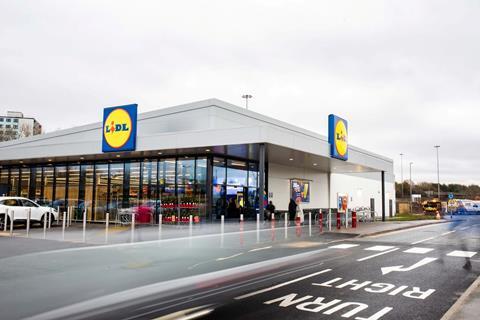
Lidl has matched Morrisons in grocery market share for the second month in a row, according to new Worldpanel by Numerator data.
Lidl’s sales rose by 8.8% year on year in the 12 weeks to 19 April 2026, to put it again level in share with Morrisons, with both accounting for 8.4% of the market.
Lidl’s share climbed from 8% a year earlier, as it acquired over half a million additional shoppers, more than any other grocer.
Meanwhile, Morrisons’ share dropped from 8.5% as its sales grew by just 1.1% year on year.
Lidl was marginally ahead of Morrisons in sales over the 12 weeks, at £3.05bn vs £3.03bn.
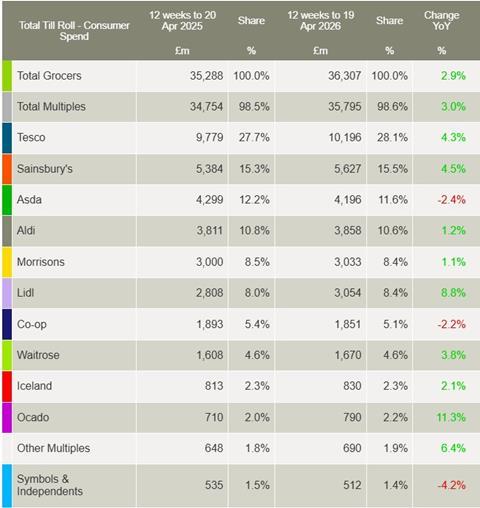
It means Lidl is again the joint-fifth largest UK supermarket, behind Tesco, Sainsbury’s, Asda and Aldi. It is also Lidl’s 34th consecutive month as the UK’s fastest-growing bricks & mortar supermarket.
In the four weeks to 19 April, total take-home grocery sales increased by 0.9% year on year, according to Worldpanel.
Like-for-like grocery inflation fell to 3.8%, the lowest level since April 2025, indicating the impact of the conflict in the Middle East had not yet filtered through to supermarket shelves.
Nevertheless, shoppers increasingly sought out deals amid concern over rising prices. Spending on promoted items over the four weeks rose 7.8% year on year, while spending on full-price goods fell by 0.2%.
“Concerns about the impact of the Middle East conflict on prices of everyday goods are front of mind for British households,” said Worldpanel by Numerator head of retail and consumer insight Fraser McKevitt. “Already feeling the squeeze at the petrol pump, shoppers are responding by turning to special offers in growing numbers when buying groceries.”
The proportion of spending on promotions stood at 31.3%, having risen year on year every month since July 2023.
Despite the concern, more premium-focused retailers outpaced the growth of the overall market.
Grocery sales at M&S – which Worldpanel does not include in its market share rankings as it does not class the retailer as a supermarket – were up 7.3% year on year.
Waitrose’s market share held steady at 4.6%, as its sale rose by 3.8%, with spend per trip growing faster than at any other grocer, according to Worldpanel.
Ocado’s sales grew by 11.3%, making it again the fastest-growing grocer outright.
Among the traditional big four, Sainsbury’s sales grew the fastest, by 4.5% year on year. Tesco’s were up 4.3%, giving it a market share of 28.1%, up from 27.7% a year ago.
Asda’s sales slipped by 2.4% year on year, leaving its market share at 11.6%, down from 12.2%. It is a faster rate of decline than the 0.9% year-on-year dip Asda notched up in March.
Aldi’s sales climbed by 1.2% year on year, well behind the total market’s growth of 2.9% over 12 weeks, while its market share slipped from 10.8% to 10.6%.
Easter spending ‘held firm’ despite consumer concerns, according to the update.
Lamb remained a popular seasonal centrepiece, with almost 9% of households buying a fresh lamb joint in Easter week. Fresh lamb joint sales in the four weeks to Easter Sunday, which fell on 5 April this year, were up by 14.9% compared with the same run-up to the holiday weekend in 2025.
Sales of hot cross buns over the same time period rose by 14%, with traditional flavours accounting for just over half of sales.
McKevitt said: “Easter is always an important indicator of consumer mood, and shoppers did not hold back on the traditional staples this year,. However, with the conflict in the Middle East continuing to fuel concerns about price increases, the promotional data suggests that shoppers are already looking for ways to keep grocery bills down.”




No comments yet