





Farmers have long faced an imbalance when it comes to negotiations with processors. Will new regulations help them to fight their corners better?
There aren’t too many dairy farmers willing to speak openly about their experiences with milk processors. While not all are bad, of course, there is often a clear fear of backlash and a loss of contracts. “I have to be very careful,” says one.
Such trepidation is indicative of a power imbalance in the dairy sector consistently identified by the government over the past 10 years. Regular reviews have concluded dairy farmers are ultimately at the whims of supermarkets and processors, at times compelled to accept whatever their powerful brokers choose to offer – whether it’s a fair deal or not.
That imbalance is exactly what The Fair Dealing Obligations (Milk) Regulations 2024 (FDOM) came in to tackle. After more than a decade of lobbying, the sight of farmers pouring milk away during the pandemic, after short-notice price cuts and delayed payments, eventually compelled the government to act, bringing in new rules to try to rebalance the scales.
Before FDOM, many farmers had either never had a contract, never read it if they had, or just held onto a scrap of paper their grandfather agreed over 50 years ago, some tell The Grocer. Now though, not only should they all have contracts, they also hold new rights. Those include transparency over how prices are set, minimum notice periods for termination and, crucially, the power to challenge perceived unfairness through a new impartial adjudicator.
But this new regime is far from perfect. Many farmers say processors maintain an unfair amount of power and sometimes use it to their advantage through periods of extreme price volatility.
This potentially matters for every farmer, with dairy a test case for similar regulation across large swathes of the farming sector.
Equivalent rules are already in force for pigs, while eggs are set to have their own by the end of the year. Regulations on combinable crops and fresh produce have been mooted.
So, what lessons have been learnt from FDOM? Are farmers now able to fight their corner?
It’s important to note the fair dealing rules are still new. While they passed in 2024, it was another year until they applied to all existing deals, to give processors time to sort out their contracts. FDOM, therefore, has been in widespread effect only since July 2025.
During the past year, milk prices have been on a rollercoaster. After soaring through the first half of last year, they fell sharply over the winter as British production hit record-highs and processors struggled to keep a lid on excess volumes. Now, prices are back on the up after the recent drought caused volumes to wither.
That volatility is not in itself a reflection of the effectiveness of FDOM, or lack thereof. The regulations were designed to improve the fairness and transparency of contracts, rather than dictate prices.
What’s in The Fair Dealing Obligations (Milk) Regulations 2024?
- Price: FDOM makes no intention to set a minimum price benchmark, or legislate any controls over price. However, all farmers must be offered clear reasoning for the factors used to calculate their farmgate price.
- Dispute resolution: A farmer has a right to complain to the processor if they feel the conditions of the deal are unfair. The processor must then have a procedure in place to “take reasonable steps” to resolve the complaint. This could involve an independent third party like an accountant reviewing the processor’s pricing model.
- Exclusivity: Processors cannot insist on tiered pricing as part of an exclusive contract.
- Cooling off periods: Contracts must include a 21-day cooling off period, during which farmers can terminate their contracts without notice and no ensuing penalty.
- Notice periods: A processor must give a farmer a minimum of 12 months’ notice to terminate the contract.
- Variation: All variations to the contract must be agreed by both parties. It means milk buyers cannot enforce changes without the permission of the farmer or their representative organisation.
- Farmer representation: The regs allow farmer-owned structures such as co-ops and DPOs to have greater flexibility in terms of the contracts they are able to negotiate.
- Complaints: The Adjudicator has the power to investigate a formal complaint and potentially fine processors up to 1% of their annual turnover. But the complainant cannot be anonymous.
While that may offer little comfort to producers facing a sudden drop in income, many are now at least receiving greater notice of price changes and a clearer explanation of how those decisions are reached.
This doesn’t mean farmers are happy with what they are hearing. To cope with elevated volumes in recent years, more processors introduced balancing schemes to try to control supply. They are more complicated than a typical supermarket dairy contract priced on a ‘cost of production plus margin’ model. Instead, they give farmers an ‘A’ price for an agreed volume. Anything delivered over is classified as a ‘B’ or ‘C’ volume, with a different associated price.
Farmers are broadly supportive of such means to help match supply and demand, but there are concerns that processors used the scheme to quickly drive prices down when volumes were strong, yet they are now holding back the equivalent price rises as volumes are dropping off.
In June, for example, dry weather meant daily milk deliveries fell 3% compared with last year, causing the spot price to rise around 50p per litre as a result, AHDB figures show. However, processors are failing to instigate price shifts at the same speed as they did when prices were falling, says NFU Dairy Board chair Ian Harvey.
“The same marginal spikes that drove the market down must surely now push prices up,” he argues. “What we should see in these contracts is that when the tables are turned, when there’s a shortage of milk, the value should find its way back to the farmer just as they found the penalty in the spring.”
Under FDOM, farmers should officially be able to ask how their new milk price aligns with their contractual conditions, to ensure it is all fair and transparent. How much have their total volumes grown? What price is the processor selling their goods at? And how are record-high whey prices factored into the price?
Farmers say, however, that answers to their questions are often not forthcoming. “I met a group of dairy farmers recently and they can’t get any response from their milk buyers,” says Verity Richards, NFU chief dairy advisor. “They won’t meet with them. They won’t talk if they ask for clarity. They just say that’s how the calculations were done and give no real detail.”
A spokesperson for Dairy UK, the trade body for milk processors, says FDOM came into effect during volatile market circumstances and, while this necessitated a rapid evolution in contracts, “overall the FDOM has provided the industry with the flexibility required to respond to a challenging market”.
They add: “Initial experience would indicate the FDOM provides the right balance between greater transparency and operational flexibility which is vital to giving the industry confidence to invest.”

“By the time you’re at the formal complaint stage, frankly it’s already too late for both parties”
A buyers’ market
With many farmers still feeling they are on the sharp end of perceived unfair dealings, it raises the question of whether they are now in any better position under FDOM to do something about it.
A farmer’s best strategy is often to try to keep options open by having numerous processors to sell to. That way, when one is deemed to be unfair they can always turn to a hopefully more favourable deal elsewhere, several industry sources say.
FDOM sought to enhance this power by prohibiting the sort of tiered pricing explained earlier in any exclusive contract, and in itself has triggered a shift away from processors issuing exclusive contracts.
The problem is that with milk volumes still relatively weak, it remains a buyers’ market. That means if a farmer does opt to ditch one processor, they won’t necessarily have anyone else willing to buy.
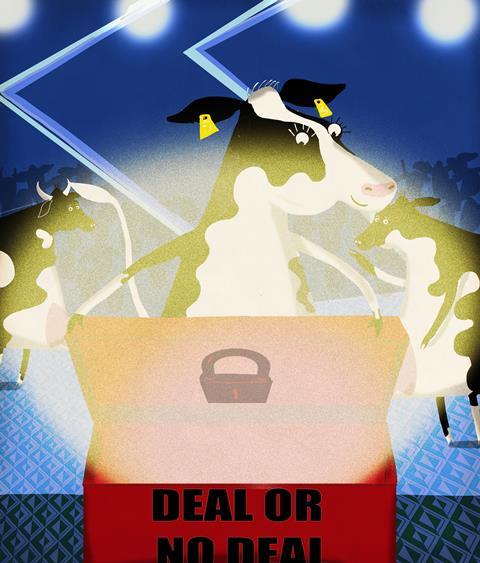
The hope is, however, that as milk prices recover, some farmers will be able to supply more than one processor for the first time and use that leverage to achieve better terms.
This, of course, relies on farmers having geographical access to multiple processors – something many in the more remote parts of the UK do not have.
“Many are ‘geographically compromised’ and then, really, it’s still in the processor’s gift,” says one dairy farmer on condition of anonymity. “The one thing we have as a farmer is ability to disagree. To veto effectively. But if you’ve got nobody else to sell your milk to, what’s the point of vetoing?”
FDOM has again sought to give farmers redress in such situations through a formal complaint procedure. This would then be investigated by Richard Thompson, the UK’s first Agricultural supply chain Adjudicator, who holds the power to fine processors up to 1% of their turnover if any breach is found.
The problem so far is that to do so, a farmer must publicly put their name to a formal complaint – something none have yet been willing to do. The main issue is that without anonymity, many fear retribution from the processor.
It is not just fear of retaliation that can hold farmers back, Thompson notes. “Some of these relationships are very long-standing, multi-generational, involving community and family relationships. So, there’s sometimes quite complex reasons why someone doesn’t want to make a formal complaint as well as the very real fear factor.”
As a result, Thompson launched a channel last year to give farmers a chance to raise issues anonymously. This, he claims, is often more effective than a formal complaint as “by the time you’re at that stage, frankly it’s already too late for both parties. Relationships have probably irreparably broken down already.”
By contrast, through the anonymous channel, Thompson says he has often been able to approach processors and raise issues without revealing the complainant’s identity, securing positive changes as a result.
It means the full legal powers of the Adjudicator are yet to be tested and farmers remain wary about just how much has changed. It is another question marker over FDOM still to be confidently answered.
No one claims the new laws are perfect. There are issues – like price – which they never meant to solve. There are also issues for which FDOM clearly still has blind spots. But for the first time ever, many farmers now hold a contract and a set of rights enforceable in law. The balance of power is still far from even, but the scales are at least beginning to shift towards a more even tilt.
How DPOs are shaking up negotiations
The power imbalance within the dairy industry has long been furthered by farmers coming to the negotiating table alone. Almost inevitably, this gives then limited leverage to push back against powerful processors.
However, the rise of dairy producer organisations (DPOs) now offers a way to redress that imbalance by giving farmers the opportunity to negotiate collectively.
DPO members can appoint an organisation to negotiate milk supply terms on their behalf.
Unlike co-operatives, which traditionally undertake processing on behalf of their members, DPOs are a looser grouping focused on sharing resources and brain power, as well as negotiating weight.
Since Dairy Crest Direct became the first in 2015 to represent farmers selling to Dairy Crest, several groups have cropped up recently in the UK, including Selkley Vale Milk Group for farmers selling to Mondelez, and Davidstow Creamery Direct for those working with Saputo.
Progress took another further big step forward last year with the launch of the Association of Dairy Producer Organisations to give a unified voice to farmers in registered DPOs.
For processors and retailers, the growth of producer organisations is a potentially dramatic change to the dynamics of sourcing milk.
A more organised farming base may mean buyers face increasingly sophisticated counterparties – farmers being better placed to challenge contract terms and push for greater transparency.
But there is a flip side for farmers. While the rise of DPOs has helped farmers represented by such bodies to benefit from the full strength of FDOM, farmers acting alone are just as vulnerable as ever.
“Where I think FDOM appears to have left the biggest gap is where farmers have no collective representation,” says Ian Harvey of the NFU Dairy Board.
“The unrepresented farmers are finding it extremely difficult in the first place to negotiate better contracts and anything they feel is wrong with that contract,” Harvey adds. “He would have to approach his milk processor directly, and have a pretty thorough, intense conversation.”



No comments yet