





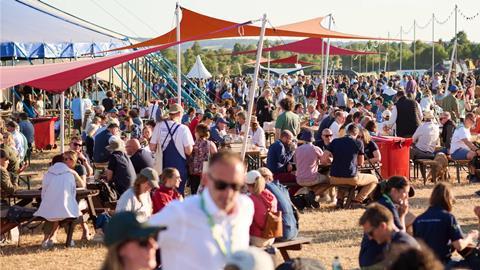
When the inaugural Groundswell Festival opened on a family farm in Hertfordshire a decade ago, regenerative agriculture was still a niche concept on the fringes of an industrial food system.
Ten years on, the festival has become the flagship event of the global ‘regen-ag’ movement. With thousands of farmers, food businesses and industry leaders streaming through the gates this morning, Groundswell stands as undeniable proof of that crucial shift into the mainstream.
No longer the preserve of idealistic farmers, regenerative agriculture is now firmly on the agenda in boardrooms across the food chain. Diageo, Unilever, and PepsiCo are among the growing number of global food businesses to jump aboard with gusto, promising to play their part in regenerating millions of acres of farmland and signalling exactly how far the movement has come.
Greenwashing at Groundswell
Not everyone at Groundswell is happy about that shift. By lunchtime on the first day, numerous farmers had already expressed concern that the movement risks being diluted and undermined as big business gets involved. “How do we stop the greenwashing element of regen-ag?” asked one attendee during the festival’s opening session.
Such concerns are not unfounded. A study by investor network FAIRR found corporate regenerative agriculture plans were “fragmented and under-resourced” with just 28% of companies setting quantified targets – down from 35% in 2023.
It comes off the back of an academic study last year which concluded regenerative agriculture had been “co-opted by non-farming actors around 2020”, as the focus largely shifted away from purpose-driven farming and towards “marketing driven by multinational companies”.
It’s a major concern for a movement which promised to change food production. But there could still be greater cause for optimism than many realise. The early allure of regenerative agriculture for big food businesses was largely due to a focus on “sustainability” and climate emission targets, neither of which carry quite the same level of corporate weight in 2026.
Sustainability has fallen down the corporate agenda as companies realised customers were mostly unwilling to pay more for it. Meanwhile, expectations around soil carbon sequestration have become more measured, with the OECD concluding it can offset just 4% of human-induced emissions.
In its place has developed a motivation that, ironically, may be more sustainable. Although positive PR remains a factor, the bigger driver is the new corporate buzzword du jour: ‘resilience’. Faced with global supply shocks, extreme weather and relentless inflation, food firms are focused on mitigating the dual risks of rising prices and stock shortages. For many, regenerative agriculture is one of the most affordable and efficient ways to guarantee reliable supplies at affordable prices.
Healthier soils mean more resilient harvests. More profitable farms mean more stable supply chains. While sustainability was often framed as ‘the right thing to do’ and sat in the marketing department, resilience is driven by economics and sits on the lips of finance execs.
The bad news, as food advisor Rob Kidd noted, is that “none of this gives campaigners the version they wanted. Inputs stay partly chemical, scale will be slow, and the practices adopted will be whichever pay for themselves, not whichever are most ambitious.”
While this is not the future many hoped for, it is considerably better than the current status quo.
Unfortunately, there will still always be greenwashers – those bad actors trying to pass off incremental change as transformation. That is unavoidable.
But they are not too difficult to spot. The best way is to simply judge the outcomes. Are the farms supplying Nestlé, Diageo, and the rest actually regenerating? Do they have more carbon in the soil, more biodiversity on the land? Are their farmers profitable?
Fail any of these tests and it doesn’t matter how it is dressed up or what techniques companies claim to be using. Regenerative agriculture must, quite simply, regenerate.









No comments yet