


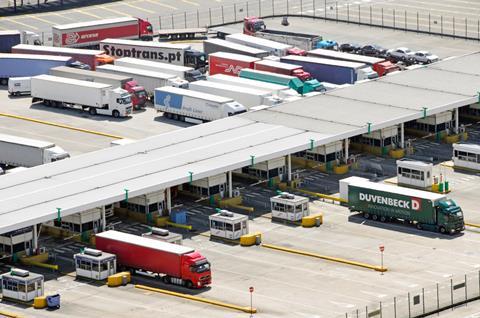
Pressing ahead with dynamic alignment with EU rules as part of the government’s ‘reset’ with the bloc has been decried as “nuts” by supply chain experts, who say it will not resolve the red tape faced by importers.
The government has framed the upcoming sanitary and phytosanitary agreement (SPS) with the EU as one that would slash the cost of exporting food and drink to the bloc by doing away with what Defra secretary Emma Reynolds described in March as “mountains of paperwork, unnecessary delays and spiralling costs”.
Europe minister Nick Thomas-Symonds added that agrifood exporters had spent £210m on “paperwork taxes” such as export health certificates (EHCs) since 2023 alone.
However, government claims the SPS deal would slash costs and red tape was significantly oversold, suggested Robert Hardy, CEO of customs brokers EORI UK. He said the agreement would merely surrender the country’s regulatory sovereignty at a cost of up to £700m a year, while leaving the real issues faced by importers unresolved.
“Traders tracking today’s friction points say the real pressure is being felt on the import side – and much of that stems from UK-designed processes that could be reformed without paying for an EU agreement,” Hardy pointed out.
Any difficulties at the border for UK exporters to the EU “tend to be down to failing to prepare rather than the process itself”, he claimed. “Dynamic alignment looks like an expensive route to solving a largely domestic problem,” Hardy added.
“It would mean tracking EU SPS rules without meaningful UK input into EU rulemaking, potentially complicating existing and future trade agreements where the UK benefits from flexibility.”
He said a “simpler alternative” would be to fix the UK import regime and its Import of Products, Animals, Food and Feed System (IPAFFS) first – a system currently fraught with cost and complexity, particularly for medium-risk imports, which often required additional documentation such as EHCs, with significant cost implications for businesses.
Since 2024, everyday EU SPS imports have been classified as low or medium risk by commodity code and composition, and the cost differential could be “dramatic”, Hardy said, pointing to the differences between two Italian hard cheeses – pasteurised Grana Padano and raw milk-based Reggiana, which were classified as low risk and medium risk respectively.
For medium-risk imports, “port health authorities also levy fees to verify risk status and cover inspection activity – even when a load isn’t physically inspected. Add the EU-side EHC cost, and importers can move from ‘tens of pounds’ per line to ‘hundreds’”, he added.
“Some 23% of the EU’s entire agrifood exports come to the UK,” he noted. “We have a strong bargaining position and a desire to make those exports and consequently our imports, easier. This should not involve us having to pay for an agreement that suits [the EU] better when the rules are completely within our gift.”
The government should instead “start with unilateral recognition, even as an act of faith, and work towards mutual recognition but please – drop the dynamic alignment idea”, he argued. “It is not required, takes too long to agree, costs too much and could be solved in so many better ways.”
Hardy’s comments echo those of ex-government advisor Shanker Singham, who in a recent submission to a House of Lords inquiry into the SPS deal said dynamic alignment was the “wrong policy”.
It would “inflict lasting economic damage on the UK through the opportunity costs of permanently surrendering regulatory freedom, provoke retaliation from the UK’s most important trading partners and leave the UK economy caught between irreconcilable legal obligations with no good exit”.
Singham also cited February research by thinktank The Growth Commission, of which he is chair, which calculated the net cost to business of dynamic alignment at £15bn, equivalent to 0.5 percent of GDP.
Hardy’s and Singham’s concerns follow warnings from the FDF and BRC that businesses are underestimating “the level of change” required to meet the demands of the SPS deal, with the two industry bodies also questioning claims the agreement will lower food prices.
The EU Alignment Bill, paving the way for the SPS agreement, is due to be laid before Parliament in the King’s Speech on 13 May.
The government has said it intends dynamic alignment to be completed by mid-2027.


No comments yet