The UK must “act now” or fall behind on land-based seafood farming, a University of Exeter policy paper has urged.
The authors said the UK had a “unique opportunity” to adopt and develop land-based seafood production technologies, which they said had the potential to “dramatically increase the supply and range of aquatic species farmed in the UK”.
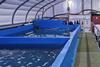
They argued for the adoption of recirculating aquaculture systems (RAS) – production facilities that use continuous water treatment and recycling.
The paper said these used up to 99% less water than traditional methods, allowed for high-quality seafood production, and provided strong “biosecurity, disease control and high welfare standards”.
Widespread investment could boost food security, create skilled jobs and position the UK as a global leader in sustainable seafood production, the authors asserted.
If not, they warned the UK could be “overtaken by countries that are investing in this technology such as Denmark and Poland”.
“The UK has the research expertise, entrepreneurial talent and growing market demand needed to lead the next generation of sustainable seafood production,” said Professor Rod Wilson, of the University of Exeter.
The paper said land used for RAS-based seafood production generated 50 to 400 times more protein per hectare than beef production.
It also asserted waste streams could generate biogas, soil enhancers and pharmaceutical products, as the same times as supporting renewable energy and sustainable farming.
Moreover, the report noted RAS facilties could be developed on ”low-productivity land”, such as brownfield sites, which could help the government meet its energy, climate and enviornmental commitments while boosting coastal and rural employment.
“This is a transformational opportunity to boost not only productivity and exports, but also the technology and engineering capabilities behind them,” added Professor Ian Bateman, co-director of the University of Exeter’s Land, Environment, Economics and Policy Institute.
The policy brief set out several recommendations for the government to scale land-based seafood adoption.
The central recommendation was for a UK Centre for Land-Based Seafood Production that would act a hub for “innovation in engineering, technology and production, workforce training, and regulatory streamlining”.
The authors also called on the government to diversify support mechanism to help farmers and investors adopt RAS technologies, and for research funding, as well as other incentives, for RAS opportunities.
The paper was launched at the Shellfish Association of Great Britain’s annual conference.
“The UK is uniquely placed to benefit significantly from an expansion in its shellfish aquaculture sector,” said SAGB chief executive David Jarrad. “Not just financially, but culturally and environmentally, while delivering on the food security agenda and supporting coastal communities with much-needed jobs.”
He added: “The industry, both marine and land based, delivers nutritious and delicious products that deliver fantastic ecosystem services, such as water cleansing and carbon and nitrogen sequestration.
“What is not to love about shellfish aquaculture?”


No comments yet