





Fast food chains won a major victory today after regulators cleared their ads of being in breach of the government’s junk food marketing clampdown.
In a string of Advertising Standards Authority rulings published today, the watchdog dismissed complaints about the ads of companies including Burger King, Domino’s, KFC and Uber Eats.
While the companies may be associated with a calorie-packed fast food ranges, the products predominantly featured in the ads were not classified as HFSS under the UK’s nutrient profiling model, according to the ASA.
The authority said the complaints reflected widespread misunderstanding among the public over the types of products covered by the new laws, which ban HFSS products from pre-watershed advertising on TV and altogether in paid-for media online.
Health campaigners said the rulings were the “inevitable” result of the government’s watering down of the HFSS marketing clampdown last year, after fierce lobbying from the food & drink and advertising industries.
The Committee of Advertising Practice (CAP) initially issued guidance that would have heavily restricted advertising by fast food brands because of their large array of HFSS products. But based on interpretation of the latest legislation, the ads are allowed to continue on air and online despite concern over their impact on the obesity crisis, according to today’s ASA rulings
Domino’s, Papa Johns and KFC cleared
One of the rejected complaints targeted Domino’s Pizza UK & Ireland’s online ads for its ‘Vegi Supreme’ pizza. The company argued the product was distinctive from all other flavour variants of pizza sold because it had tomatoes, green and red peppers, mushrooms, red onions and sweetcorn as toppings. It argued all sizes of the pizza in question were non-HFSS.
The ASA said it had scrutinised the company’s website and found the product was “distinguishable” from the majority of the other pizzas on offer, including those with meat toppings such as pepperoni, bacon, chicken, sausage, ham, ground beef or meatballs. Others showed pizzas with sauce drizzled over the toppings.
“Because meat toppings or a sauce were visible on those pizzas and were not present on the pizzas in the ad, we concluded that those pizzas were visually distinguishable from the pizzas in the ads,” the ASA ruled.
Read more: Lidl and Iceland first businesses to breach junk food ad ban
Another complaint focused on a Netflix campaign for Burger King and Uber Eats, featuring an image of a burger in a bun with lettuce, onions and text stating “When you’ve adult’d enough”.
Uber Eats argued the Burger King Whopper was not classified as HFSS and was not a “less healthy” food. It said that because the Whopper was Burger King’s signature burger it would not be mistaken for any other burger on the menu.
The ASA said it studied the Burger King website and concluded the image was distinguishable from other burgers sold by the chain, such as Whopper with Bacon and Cheese, a Double Whopper, and a Double Whopper with Bacon and Cheese.
“We noted that the number of patties in the bun, or the inclusion of cheese and bacon, distinguished those burgers from the burger shown in the ad,” it said.
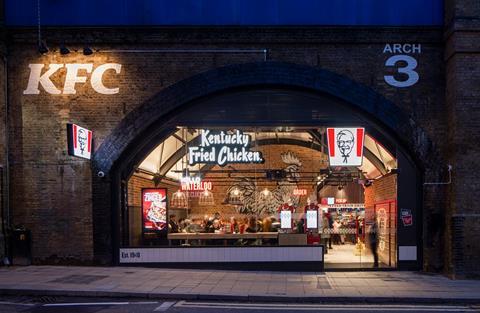
Another campaign cleared of breaching the rules was for chicken giant KFC, whose ads featured the slogans ‘Let chicken consume you’ and ’The double deal’, accompanied by shots of breaded chicken being fried in oil. The ad also showed a close-up of two breaded chicken burgers and two KFC-branded cups of an unidentified brown-coloured soft drink.
The ASA found the non-HFSS burgers shown were distinguishable from other KFC products including Tower Burgers and The Hot Honey Drip Burger, which included multiple layers and contents such as cheese and sauce. All the drinks featured were also deemed non-HFSS.
Another ad, for Papa Johns on Facebook, was cleared because the pizza it showed was not classified as HFSS and was deemed visually distinguishable from the less healthy pizzas sold by the company.
Read more: HFSS ad ban’s first rulings show the devil really is in the detail
Woking chicken shop in breach of rules
However, while the regulator cleared the fast food giants, a complaint against Morley’s Chicken in Woking was upheld. The paid-for Instagram ad promoted two meal deals featuring burgers, wings, nuggets, fries and drinks, and breached rules because products classified as less healthy could be clearly identified, according to the ASA.
Mars Wrigley was also found to have breached rules with a paid-for Instagram ad for M&M’s. The ad’s oval yellow character was found to have depicted a specific less healthy product in the form of peanut M&M’s, rather than being a generic promotion of the brand, which meant it was in breach of the rules, the ASA said.
“Our job is to apply the new less healthy food rules, which mirror the law, accurately, fairly and consistently,” said ASA CEO Guy Parker. “Today’s rulings provide clarity on how the ‘brand exemption’ aspect of the rules applies in practice.
“They also show that less healthy products can be hard to spot. Some specific products that people understandably assume are less healthy, are not in fact classified as less healthy under the government’s nutrient profiling model. That might sometimes be because food businesses have reformulated them to bring them below the less healthy threshold.
“It’s worth mentioning that government has been clear that it wants the restrictions to incentivise food businesses to do exactly that: reformulate their products so they are no longer classified as less healthy.”
Katrina Anderson, principal associate at law firm Mills & Reeve, told The Grocer: “The latest set of rulings illustrates how the ASA is approaching the brand exemption in the context of an advertisement that features a non-HFSS product which could be mistaken for an HFSS product from the same range. The ASA is systematically comparing such products with others to determine whether the non-HFSS product is sufficiently distinct to allow the advertiser to rely on the brand exemption.
“The rulings also demonstrate the extent of the reformulation work that has been undertaken by food company in response to the ban. As a result, some products that might be regarded as unhealthy or HFSS are, in fact, classified as non-HFSS.”
‘Government backtracking’
However, Fran Bernhardt, commercial determinants co-ordinator at Sustain, said the rulings showed the failure of the ad clampdown thanks to the government’s backtracking.
“These failures to regulate unhealthy food advertising are the direct, inevitable consequence of the government’s decision to bow to industry pressure,” she said.
“The standards still allow companies to advertise deals which include unhealthy foods. The government must protect children from all unhealthy food advertising by tightening up the policy now.”









No comments yet