





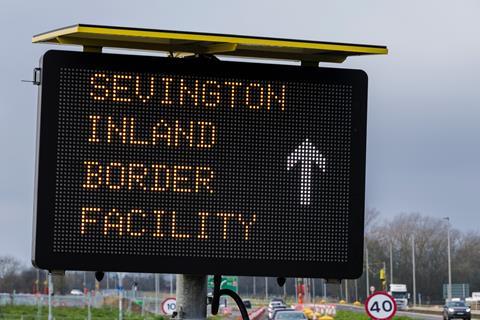
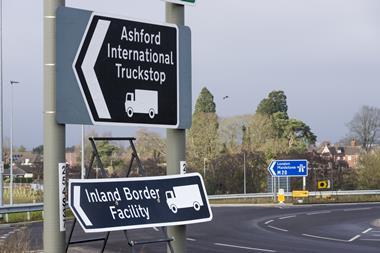
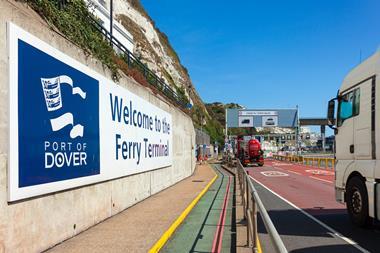
Criminal gangs are exploiting lax surveillance at Dover and bypassing its inland Border Control Post (BCP) at Sevington to bring illegal meat and plant products into the UK, the Commons Environment, Food and Rural Affairs Committee has warned.
Defra data provided to the committee revealed a significant increase last year in non-attendance at the BCP near the Kent village, located 22 miles from the port.
So-called ‘drive-bys’ of “disease-risk” illegal meat and plant products – where vehicles swerved the facility after being directed there from Dover – rose from 8% last August to 18% in November, the data showed.
Drive-bys had fallen from a figure of 40% in November 2024 – when BCP inspections at Sevington were in their infancy, and at a far lower level (208) compared with the 2025 dates, when 1,163 and 1,121 vehicles were checked in August and November respectively.
Defra’s evidence paper to the committee argued the fall in non-attendance last year demonstrated a growing “familiarity” with inspection requirements, under the government’s post-Brexit Border Target Operating Model regime of checks.
Read more: Defra currently without food and farming strategy, Efra committee chair warns
The government department also stressed the data on non-attendance represented “the maximum potential level of non-attendance among those which were selected for BCP inspection”. As a single lorry could carry multiple consignments, “the number of non-attending vehicles will be considerably lower than these numbers”, it added.
‘Dysfunctional system’
However, the data still painted a picture of a “dysfunctional system”, claimed Efra chair Alistair Carmichael MP, with a “reputation” for inadequate controls at Dover enabling criminal gangs to disregard regulations to “bring products into Britain that would not legally be sold on the continent”.
The committee cited its own damning report into lax border controls, published last September, which highlighted how the Sevington facility was “inadequate because it relied on drivers acting in good faith by taking their consignments there for checks, with very little risk of enforcement if they failed to do so”.
It had become clear “that many flout this requirement and continue driving to their delivery destination, and there remains the opportunity to unload consignments prior to presenting at Sevington itself”, it argued.
“Unchecked meat and plant products carrying potentially devastating diseases are being let in through the front door,” Carmichael said.
“The risks to our livestock and plants are grave and very real. Both the horticultural and livestock sectors see this as a disaster waiting to happen. The government has put all its eggs in the Sevington basket and it needs to make this system work at least until a new system can be agreed with the EU.”
Carmichael added that a source of “both hope and frustration” came from the suggestion from the data that when enforcement increased last year, and authorities “chased up drivers”, the drive-bys fell and more checks were carried out.
Illegal meat threat at border ‘won’t wait’ for EU SPS deal, MPs warn
“But that was apparently only a pilot and only for plant products,” he pointed out. “In other words, government won’t commit the resources to keep this going and have not so far expanded it for meat and dairy imports. How terribly short-sighted that will look if another outbreak of foot and mouth arises from this farce.”
His comments follow an admittance to the committee by FSA CEO Katie Pettifer in December, that the regulator had been given no extra cash to oversee the huge shake-up of food and animal welfare checks at the border – expected once the UK’s new Sanitary and Phytosanitary (SPS) deal with the EU comes into force.
It comes as the committee heard from Defra officials yesterday that “follow-up” checks with vehicles and consignments that do not attend Sevington were carried out.
However, they did not elaborate on how frequently this happens or how they are carried out “as they do not have data”, Efra said.
Inspections ‘mess’
The latest revelations around border controls follow warnings, as reported by The Grocer last week, that UK-based exporters to the EU are also facing significant issues at France’s SIVEP inspection office in Calais – this time via increasingly onerous inspections.
Provision Trade Federation director general Rod Addy said the situation was a “mess”, with the soaring cost of delays and rejected loads for often questionable reasons prompting “causing even the largest exporters to question whether sending loads via Calais at all is worth their while”.
The government has stressed on a number of occasions that border issues will be resolved once the SPS deal, which is currently being negotiated, is completed.
However, the Efra Committee has previously warned the illegal meat threat at the border “won’t wait”. And it remained “unclear what the future of the Sevington facility would be under a new border check arrangement”, it said this week.





No comments yet