



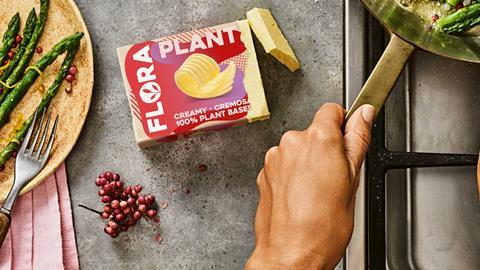
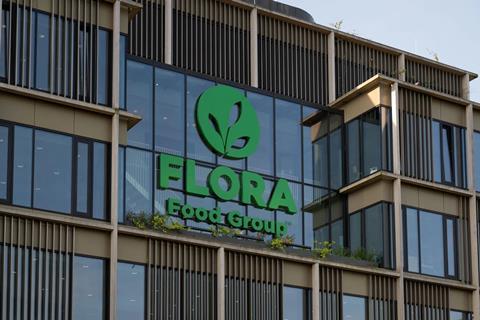
KKR has reportedly put Flora Food Group up for sale. Eight years after it won a hotly contested auction to buy the spreads group from Unilever, it’s about time the PE giant sought a return on its investment. And the $10bn asking price wouldn’t be a bad return on its €6.8bn ($8bn at the time) initial purchase.
Whether anyone will stump up the cash is another question.
Flora’s not been the stellar performer that KKR might reasonably have hoped for. When the firm bought it, the margarine giant seemed well-placed to take advantage of a plant-based boom that was just gathering pace – but KKR’s big bet never really came through.
Despite the bolt-on acquisition of vegan cheese brand Violife, sales have stagnated at just 1% CAGR between 2019 and 2025, when the group turned over €3bn. Steady and dependable – but well behind inflation across the group’s global markets, and with little sign of any success for the broader plant-based strategy.
Flora’s failed turnaround
More importantly for KKR, while the group made swift work of upping prices and fixing its promotional strategy – “giving it the love Unilever didn’t”, in the words of a senior City source – Flora has continued to struggle with declining volumes and high input costs.
Turning around such a giant is a herculean task, the source adds: “They tried to do too much, and didn’t have the boots on the ground to make it happen.”
Now appparently up for grabs again, the group remains shockingly overgeared from its last sale, has a massive and complex supply chain, and is facing significant headwinds.
For one, consumers have turned against processed foods. It’s ironic that margarine, once heavily marketed by Flora and others as better for health, is now cursed as a UPF. Equally, the seed oils used to cut cholesterol and saturated fats, while making blended butters more spreadable are now – albeit dubiously – being blamed for all sorts of ailments, from chronic inflammation to hormone imbalances.
The turn towards butter has been pronounced in the UK, with NIQ data showing a lurch away from anything spreadable – if it’s not in a block, consumers don’t seem to trust it any more. It’s tough timing for Flora to have revived the old I Can’t Believe It’s Not Butter brand: a name increasingly sounding more like a complaint than a boast.
In the 52 weeks to 21 February 2026, volumes for Flora’s namesake brand dropped 4.1%. Flora Pro-Activ’s volumes were down 7.9%, Bertolli was down by 12.4%, Stork 5.8% and I Can’t Believe It’s Not Butter by 15.1%.
At the same time, investors remain wary of the plant-based market – a “busted flush” for growth, according to another senior City source. After buying Violife in 2020, the group announced it would make its entire portfolio fully plant-based by 2050.
A plant-based correction
It’s not all bad news for KKR. The fact remains there really are very few assets like Flora out there.
Firstly, it’s massive. It turns over €3bn annually, and generates a huge amount of cash from a global platform. And continued investment under KKR has meant it’s more innovative than ever.
Secondly, while investors might be sceptical of the plant-based market, it’s here to stay.
“The sector has clearly been through a correction, but that is different from saying the underlying opportunity has disappeared,” says Indy Kaur, CEO of sector consultancy Plant Futures.
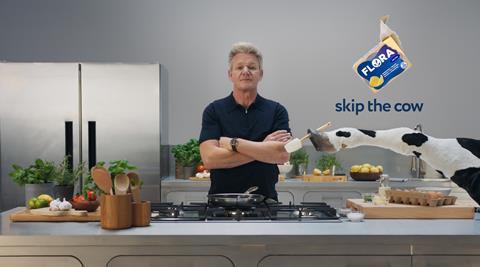
Since Flora’s acquisition in 2018, dairy alternatives have become a core supermarket fixture. And while the initial hype may have faded, that mainstream adoption is currently funding a stream of innovation.
A massive, stable, and potentially highly profitable Flora may well find another private equity firm to be its most likely buyer. Only a few are large enough to marshall the funds to buy it – such as big ticket firms like Cinven or Blackrock. They may well be joined in the bidding by sovereign wealth funds.
But there is another option. Any one of the four global ingredients giants could throw their hat in the ring: ADM, Bunge, Cargill or Dreyfus.
Accounting for 75% to 90% of the global grain trade, these heavyweights certainly have the means to buy Flora. And they could see it as an opportunity to add margin to their B2B portfolios, as well as giving them direct access to retailers, and a consumer-facing brand. It would be a compelling strategic play.
The question is whether anyone bites. It would require a sizeable cheque for a heavily-indebted asset in a steady, rather than exciting, category that is still facing volume pressure in developed markets.
So will KKR find a buyer? The jury, for now, is out.


No comments yet