




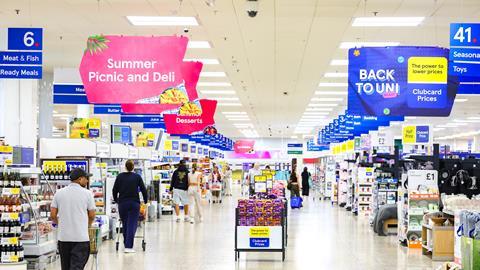
Tesco’s claim sounded really credible and specific: 114 additives banned or restricted in response to its research that 80% of its shoppers wanted to eat fewer processed foods but found it hard to navigate the issue.
Headlines included The Sun’s “Tesco announces ban on over 100 additives in major clampdown on processed foods”.
Tesco wasn’t aiming to be UPF-free. But the risk, of course, is that anyone looking to avoid UPFs might assume they could rely on Tesco’s own-brand food and drink rather than fretting in the supermarket, scrutinising the back of every label. Shoppers would be forgiven for thinking that the headline was earned by a marked change to those recipes.
But the claim was impossible to put into context. Tesco wouldn’t say which additives it had banned, which it was restricting, how it had decided on what to include in its list, where it was on the journey or, crucially, how long it would all take.
Which is why we asked health app Yuka to run the numbers.
The reality proved far more complicated. Of 4,196 Tesco own-label food and drink products on Yuka’s database, 1,282 contained at least one additive it classes as high-risk. It is worth repeating that Tesco’s additives are all approved by the FSA, and that it doesn’t use any more of them than the other major multiples.
The high-risk designation itself is not without contention. Just look at the battle waged against the FSA by Coalition against Nitrites. Yuka, though, is transparent about the criteria it uses to classify additives as high, moderate, limited or risk-free.
The assessments draw on peer-reviewed studies and reports by global health bodies, and Yuka links to the science so that consumers can make an informed choice on which products they buy. Everyday staples like bread, wraps, mayonnaise and reduced-sugar ketchup are some of the most-scanned products.
The additives Yuka found broadly fall into two buckets, preservatives that extend shelf life and cosmetic additives that make products more palatable.
The two most prevalent additives Yuka rates as high-risk are mono- and diglycerides of fatty acids, emulsifiers that help ingredients combine and give products a soft, smooth texture; and disodium diphosphate, which is used to help dough rise and retain water in meat.
There is a commercial first-movers’ disadvantage risk in both cases. Remove preservatives and you reduce shelf life, driving up food waste and adding costs to retailers and suppliers alike. Take out additives that improve appearance, intensify taste or create a pleasant texture, and you risk lowering sales and consumption.
As Julie Chapon, Yuka’s co-founder, says: “Reformulating takes time and investment, and in many cases it means manufacturers must accept lower margins. A credible commitment sets priorities and a timetable rather than promising everything at once.”
Proof of what’s possible
Chapon points to Europe for proof of the possible. “Our analysis of the French market found the average number of additives in processed foods fell by 7% between 2018 and 2025, and by 13% for those we rate high risk, with much larger drops in some categories: cereal bars down 75% in high-risk additives, ready meals down 48%,” she says.
Tesco has real sway. It has a chance to set the agenda and lead from the front. In many ways it already is, launching own-label nitrite-free ham, and a search function that lets online shoppers filter out additives.
In response to our story it said that “presence of an additive today should not be taken as evidence that action is not happening”, and that reformulating products takes “several years rather than several months”.
Why not say so from the outset? Commit to regular updates and share progress to build trust with the consumers who worry most about this stuff. Throw down a challenge to your rivals when you’ve banned something new. It’s a journey of thousands of steps, not a one-and-done job.
For now, consumers worried about additives should still spend time with the label. Tesco has an opportunity to make that easier – but it needs to be clearer about what it has changed and what comes next.






No comments yet