


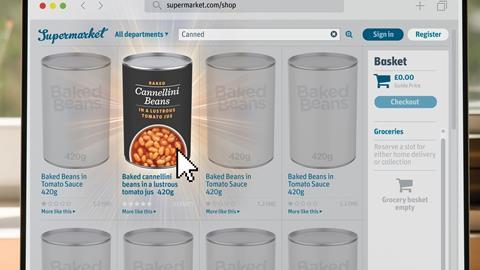
Simply shrinking pack pictures won’t do when it comes to driving online sales. What works best?
That’s a car crash,” says former Unilever director of content Oliver Bradley, as he scrolls the shopping pages of Tesco.com. He clicks on a beauty product. “That’s unbelievable. Just horrendous,” he says.
From the ‘hero image’ alone – the picture of the item used in search results and the main image on its product page – it’s not immediately clear what the product is. “You can’t read the brand, you can’t read the format, you can’t read the size,” he explains. “The contrast is so bad, you can’t read anything. And I’m on a desktop.”
It’s not a one-off. The websites of all the major supermarkets are littered with duds like this – with examples ranging from challengers to multinationals. And the unreadable hero images, as well as lacklustre product descriptions, poor discoverability and general lack of supplier attention, are losing valuable sales.
Tellingly, the content for online supplied by brands to supermarkets scored poorly in the latest Advantage Group survey of retailers. The “effective content” supplied was rated as one of the worst of suppliers’ e-commerce capabilities, and it’s getting worse – suffering the biggest drop of all measures since last year.
So, why is it happening and what can be done? Is it only brands to blame? And does it really matter?
The reasons bad imagery reaches supermarket websites can be as simple as lack of care and attention.
Standards to ensure ‘glance readability’ of hero images – from which shoppers can immediately ascertain the brand, format, variant and pack size in an instant, even on a mobile screen – have existed for several years. At Unilever, Bradley worked with University of Cambridge researchers to help create GS1’s standard for mobile-ready hero images, released in 2017.
That doesn’t mean they’re followed, says Bradley – now chief digital officer at commerce agency Neem. Often, “the designer and brand manager are in their 20s with near-perfect eyesight. They eyeball it, and the ugly truth is it’s created on a 32-inch, 6K Retina Mac screen and approved on a 14-inch HP or Dell laptop and nobody ever looks at it on mobile for approval,” he says.

Or, if not done in-house, brands “don’t have time or don’t check on the agency”, Bradley adds.
When images are checked for readability, it’s often done manually and sporadically. “The critical mistake is designing for the physical shelf, then shrinking it to a thumbnail,” says Dr Alastair Goode, cognitive scientist at creative testing tech firm Dragonfly AI. “On a supermarket search results page, hero images have milliseconds to win pre-cognitive attention – at mobile size. Designs that work beautifully in store become illegible: brand, variant, pack size disappear and visual clutter scatters what little attention they capture.”
‘Small fixes, big returns’
Fixing them can make a huge difference. When Dragonfly AI worked with Reckitt, the multipack hero images of several of its products on Amazon were capturing just 5.7% share of attention against competitors online. Optimising the images drove a 20%-30% conversion uplift.
Dragonfly also helped a major supplier lift conversion 70% on a single milk SKU by redesigning one hero image for Tesco.com. In another example, return on ad spend rose by up to 82% on redesigned hero images during a supermarket promotion, while the product’s visibility on Tesco.com increased by 62%.
As Goode puts it, “small fixes, big returns”. But it’s not just hero images that separate bestselling brands from those that are scrolled past. Best practice includes providing supplementary imagery, video, bullet points and product description; proving superiority claims; and including user-generated content and reviews.
All text should be easily digestible and in short sentences. “And don’t write in all caps,” Bradley says, which research shows makes reading speed 10% slower. While maximising the available content fields, it’s crucial to have “fewer than four key messages”, Bradley adds. Current research shows the average person has a ‘working memory’ of three to four things.
Ultimately, the content needs to be quickly readable and stick in the consumer’s mind. “If you’re not scoring well on attention, God help you,” Bradley says.
Case study: how Mars Petcare ‘fully integrates’ online

Unlike many brands, Mars Petcare has “fully integrated” online into the commercial strategy, e-commerce director Antonella Hayes tells The Grocer.
On supermarket websites, Mars pet brands – among them Sheba, Whiskas and Pedigree – truly shine. There’s clear imagery, messaging that hits home, video content and products organised by use case and customer mission.
“We ensure all our retail partners have accurate, compelling and highly optimised content across our entire portfolio, from existing products to new innovations. We also recognise that great content is never ‘finished’, which is why we continuously test, measure and refine everything,” Hayes says. “This optimisation helps ensure our products are easy to find, stand out in search results and provide shoppers with the information they need.”
It’s easy to simply blame brands for these failings. Retailers surveyed said suppliers failed to demonstrate “a clear vision for online channel opportunities”and lacked a “strong understanding of the category from an online channel perspective”. Performance on both measures was down on last year.
Laying that all on brands is probably unfair. “The diagnosis is off,” says Michael Duffy, SVP, global creative director at Equator Design, which has worked with Ginsters, Miller, Beyond Meat and Co-op. It is “often a packaging and content problem, not an attitude problem”, he argues.
At the same time, brands might not prioritise the digital shelf due to, as one chilled challenger brand puts it, “the size of the prize. We have to be mindful that it’s still a small percentage – about 20% – of sales overall.”
Like many challenger brands, their business doesn’t have a dedicated online sales team. “It’s more challenging for smaller businesses, because in a small team everyone is across everything, so it’s not straightforward to provide that dedicated focus,” they say.
That’s a common scenario, says Duffy. “We see this constantly: smaller suppliers rarely have anyone whose actual job is e-commerce content,” he says.
“What they have is a marketing generalist producing retailer-compliant imagery and copy across five platforms. Building proper digital shelf content is a specialist discipline. A large branded supplier can justify a team for it; a smaller one is sometimes improvising.”
Then there’s the constant juggling act faced by challenger brand teams. Matt Bowler-Jones, CEO of functional drinks brand Hip Pop, says “challenger brands are often managing new listings, stock, promotions, samples and different retailer systems at the same time with limited resources. Keeping every product page accurate and engaging across multiple retailers takes more resource than people realise.”
How AI is levelling the playing field for challenger brands
That’s not to say shining on the digital shelf is beyond the reach of even bootstrapped brands. Testing digital shelf creative used to cost thousands of pounds per asset and took weeks. In other words: “Viable for large campaigns; impossible for challengers,” says Goode. But AI has helped speed up and lower the cost of the process. It’s “levelled that field”, he argues.
“Hero images can now be scored and iterated in seconds before going live. If anything, smaller brands have an advantage: fewer sign-offs between insight and action,” Goode says. “The democratisation of measurement means even one-person operations can develop intuition for what works and why, applying universal principles of cognitive science across their range.”

Plus, even the well-resourced fmcg giants face their own issues. Often, there is lack of clarity over ownership of the digital shelf, which can be “fragmented”, says Goode.
“It’s more often about company structure than suppliers not caring,” he explains. “Inside most CPG businesses, digital shelf ownership is fragmented: brand teams own the pack; agencies own media; e-commerce teams chase conversion metrics. Nobody owns quality end to end, and there’s no common measurement language between them.
“Vision emerges from treating the digital shelf as a creative channel in its own right, grounded in human perception and cognitive science – not in legacy practices built for physical retail,” he adds.
Some brands do get it right. In the Advantage Group survey, retailers held up Unilever Homecare and Mars Petcare as exemplars.
Unilever understands, says Kat Simpson, commercial & strategy director of Unilever UK, that “the way people shop is evolving” – and businesses must too.
“Shoppers increasingly research products online and often move between retailer websites, social media and search in one journey. We’re focused on making our brands easy to find, choose and buy wherever people shop,” she says. “We work closely with our retail partners to create a frictionless shopping experience through insight-led, channel-ready content.”
What retailers need to do better
Still, the onus isn’t all on brands to improve. Retailers could be doing more to help them, many argue. Each retailer has its own product page specifications and format requirements. None supply automated tools for pre-testing of creative assets. And, as one supplier explains, many are sluggish on improving the online offer for brands.
“Do they have the ability to support video? Hurry up and provide video,” they say. “Do they have an LLM agent that helps with search instead of a really terrible search you can hardly work? Do they have enhanced content below the fold where you can do a bit more storytelling if you’ve got a new launch?
“Stop sitting around, build out your content field. Why are you twiddling your thumbs?” they add.
The issues on both sides “compound each other” reckons Duffy. “Every retailer platform has its own spec and format requirements, and few suppliers have specialist resource to service that well.
“So brands either duplicate expensive photography and render work across platforms or reuse physical-shelf assets never built for a 1cm thumbnail, which quietly under-convert as a result. The fix is treating the digital shelf as a design brief in its own right, not an export setting.”
Regardless of who is at fault, the truth remains: brands need to take the digital shelf seriously for their own commercial benefit. Even if online represents only a minority share of sales, Bowler-Jones points out “the digital shelf is often where someone first discovers your product, so strong imagery and accurate information can make a real difference”.
Plus, disappearing into the background online hits not just online sales, but store sales, too. While pure online might be about a fifth of a supplier’s sales, total sales that involve at least one digital touchpoint – a review engine, retailer website or coupon website – surpass 60%, according to analysis by Flywheel Digital, a figure it expects to reach 70% by 2027.
According to Salsify research last year, 71% of UK fmcg shoppers research new products and brands on search engines and 60% on online marketplaces. Some 70% have ‘webroomed’ – that is, researched a product online before buying it in a physical store.
And after all, says Bradley: “Which is easier to fix: 3,000 Tesco stores or Tesco.com? All of the growth is coming from online, literally all of it. And once your product is locked into that favourites list, your loyalty is taken care of forever.”






No comments yet