From leadership lessons at Asda to in-store AI, retail media realities and digital excellence, Retail Week x The Grocer LIVE 2026 delivered a clear message: modern grocery success is built on execution, not hype.
Opening the day, Allan Leighton spoke to The Grocer’s editor-in-chief Adam Leyland about taking on what he described as the toughest job in UK grocery: restoring Asda to its former strength. It is a challenge he knows well, having led the supermarket’s near-legendary turnaround in the late 1990s.
So what should the next generation of retail leaders take from his return to the frontline? For Leighton, leadership fundamentals have barely changed.
“The role of leaders is to simplify the business, put pace in the business and keep people motivated,” he said. “It isn’t any more than that. Very easy to say, very difficult to do.”
Central to that is how leaders listen. “There are two types of listening,” he explained. “There’s listening to respond, which most of us do. And there’s listening to hear, which is completely different.”
Leighton said he now spends much of his time in stores, talking to colleagues and customers. The same principle applies to communication. “A lot of what people call communication is just talking at people,” he said. “Whereas the art is to talk with people.”
Get those basics right, he argued, and the rest follows. “If you talk with people and you listen to hear, then try to build simplicity, pace and motivation into the organisation, that’s the kernel of leadership. I don’t think it’s changed very much.”
Retail media ain’t easy
That emphasis on fundamentals echoed through a later deep dive into what speakers described as ”retail media 3.0” – and a collective effort to puncture the idea that retail media is easy money.
“Firstly, it’s not easy,” said Adam Smith, Iceland’s head of retail media. He outlined the scale of organisational change required to make retail media work, with executive buy-in and internal alignment critical to avoiding confusion and “noise” in store.
At Co-op, the challenge looks different. Head of media network Dean Harris said convenience retail required a fundamentally different approach. “We planned Co-op Media Network a year before we launched it, but had to get a commitment for a five-year plan,” he explained.
Most of the work, Harris said, was internal – but the most important shift was cultural. “A lot of retail media networks still call brands suppliers. We call them clients.”
For Gemma Haley, proposition and strategy lead for retail media at John Lewis, retail media is a “non‑negotiable part of modern retail strategy” and “can’t be treated as a side hustle”.
Taking a premium approach, she said Waitrose and John Lewis assess every opportunity through a “win‑win‑win” lens that balances retailer, brand and customer needs. Premium customers, Haley argued, still expect value – but also inspiration, relevance and experiences that feel native to the brand.
Where AI and stores meet
If retail media isn’t plug-and-play, neither is AI – but speakers were clear that its role in physical stores is accelerating fast.
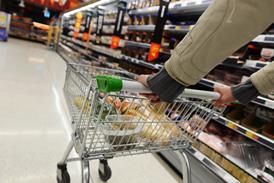
David McIntosh, Instacart’s chief connected stores officer, outlined how smart shopping trolleys are being used to gamify the in‑store experience. While built‑in screens help shoppers track spending and reduce impulse purchases, they are also emerging as powerful retail media platforms.
“The value of the screen is huge – it drives double‑digit basket uplift,” McIntosh said. He highlighted a “forgotten essentials” feature that prompts shoppers with reminders based on previous behaviour. “That one feature – ‘Did you forget the yoghurt?’ – lifted baskets 1%.”
The advantage of physical retail, he argued, is that AI can respond to real‑time behaviour rather than abandoned online intent. “If you can gamify the experience, that creates a massive advantage for grocers.”
Data remains the foundation. Sathya Nandakumar, chief technology officer at Holland & Barrett, was blunt: “Whoever has got the tech with the right master data, customer data – they are going to be the winners, AI or not.”
The business of building hype
Elsewhere, attention turned to whether viral moments and “breaking the internet” still matter for grocery brands. They do – but only if retailers can deliver.
Sharry Cramond, marketing director at Marks & Spencer, said hype works when stock availability matches consumer excitement. Dan Murray, founder of supplements brand Heights, agreed that failing to serve sudden demand can quickly turn buzz into backlash.
Both described being directly involved in content creation themselves, with Murray confessing to hauling a water cooler around London in the name of brand building.
Katie Kinchin‑Smith, head of brand at The Very Group, spoke about the delicate balance of growing both the Very brand and the brands it hosts – a challenge requiring careful collaboration rather than competition.
Argos sets the digital bar
The event also launched the Digital Capability Index (DCI), a new ranking by Retail Week and The Grocer assessing how well 65 major retailers meet consumer expectations online. Argos narrowly beat Tesco to take the top spot.
The omnichannel pioneer led the field thanks to features customers say matter most, from same‑day delivery to flexible payment options.
“What the report shows is that sometimes the bar set by consumers can be hard to meet,” said George Arnett, Retail Week’s intelligence and insights editor. “Free online returns, for example, are now offered by a shrinking pool of brands.”
Argos’ win, he added, reflected sustained investment in meeting those expectations. It echoed the lesson learned across much of the day - in modern grocery, ambition only counts if it’s matched by execution.


No comments yet