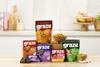
Unilever has taken another small step in cleaning up its portfolio and trimming down in food today, offloading Graze to Candy Kittens.
The move is a huge stride for the popular confectionery challenger, however, as it moves its business from sweets into the savoury snacking aisles.
Plenty has already been written (including by me) about the underperformance at Graze while in Unilever’s hands. It’s been unloved and ignored, lost in the depths of the mammoth Unilever machine since the 2019 acquisition.
That’s not to say Unilever hasn’t done necessary work on the business: pulling it out of North America in 2019, shutting down the DTC channel entirely last year and building solid relationships in UK retail. A long overdue integration into the wider UK Unilever food business also completed in 2024, which will help Candy Kittens’ parent Katjes swallow the brand that bit more easily.
Candy Kittens is definitely a leftfield new owner for Graze, but it makes strategic sense. Graze supplies several sweeter flapjacks along with the more savoury nuts and roasted corn and broad bean sharing bags, so it’s not that much of a stretch for the brand. And Jamie Laing and Ed Williams will inject much-needed excitement, energy and innovation into Graze (see the tie-up with Katjes stablemate Genius to launch a co-branded rocky road earlier this year).
But for all Candy Kittens’ talk of Graze being a “category-defining” business that has built strong brand loyalty, it’s not in the same league as Unilever’s remaining non-core food assets.
What about Marmite?
Marmite, and, to a lesser extent, Bovril and Colman’s, are headline-making brands. Staples that have won the hearts and minds of consumers for more than a hundred years to become part of the UK’s heritage. And, just like Graze, all three are unlikely to feature in Unilever’s future.
Last month, Reuters published an exclusive claiming Unilever was considering selling all three brands. The story was rather strange – if not at all surprising (an expected Marmite sale has been written about since ex-Unilever boss Hein Schumacher launched his 2023 ‘action plan’, with expectation only increasing since CEO Fernando Fernandez took the driving seat and accelerated the strategy). Both vague and specific at the same time, it contained no detail on any bankers appointed to run a process. No timescales or potential buyers. But it did say Unilever would be keeping hold of Pot Noodle, which had previously been mooted as non-core.
A raft of City sources told The Grocer they have no insight into any potential process and it remains unclear if Unilever has yet engaged advisors. All agree discussions remain at a conceptual stage. A formal process isn’t expected until sometime next year, making a sale unlikely before summer at the very earliest.
Unilever, for its part, is keen to emphasise talk of a sales process is premature, far from fact and pure speculation at present.

What we do know is outside ‘power brands’ Hellmann’s and Knorr – and once the ice cream spin-off completes this month – Unilever is very much focused on higher-margin health, personal care and beauty brands (see acquisitions of Wild and Dr Squatch this year for an idea of direction of travel).
The business did share some helpful insight today following the Graze disposal.
“Unilever’s ambition in foods is to deliver consistent, top-tier performance in its peer set, and will do that by rigorously focusing on three attractive global categories: condiments, cooking aids and mini meals, and Unilever Food Solutions,” the group said. “This is where Unilever has proven capabilities to win, anchored in its large, global power brands, and is sharpening its portfolio for long-term growth and scalability in these areas. This includes pruning the portfolio where relevant.”
It seems almost certain Marmite, Bovril and Colman’s will be pruned in time.
‘One yeasty bite’
Despite being household names, these three are not exactly growth brands. Although exact financials are hard to pin down individually, combined UK sales are reported to be around £200m a year and steady.
So with Unilever’s focus on power brands, it’s clear, like Graze, these historic businesses would be better served by a new, more focused owner.
A big international push will likely be needed to squeeze more growth out of all three, as well as a hard look at what can be cut back in the guise of efficiency savings.
All three brands are manufactured in Unilever’s Burton upon Trent factory, which underwent a £40m upgrade in 2024 to double total output. However, the investment could potentially complicate a sale, as Unilever then bought Hellmann’s to the site, making it a specialist condiments hub. So, a solution will be needed.
The question is will Unilever look to sell each brand individually or as part of a package? On past form, including Graze and The Vegetarian Butcher, the group likes to go asset by asset to maximise value. But it also makes sense to market Marmite and Bovril as one yeasty bite.
Although, a bundled sale of all three also potentially brings private equity to the party as a buyer. Remember, the Unilever tea portfolio was sold to CVC back in 2021, while spreads went to KKR in 2017.
No matter how Unilever decides to do it, there is likely to be high interest from buyers in the UK and further afield. And it’s worth speculating a little about who might be in that pool of interested parties.

The acquisition trail
It’s surely a no-brainer for Premier Foods, which is already on the acquisition trail and looking for more. All three brands would slot nicely into the Oxo and Bisto owner’s portfolio. On the other hand, the most recent Premier deals have been for growth brands (The Spice Tailor, Fuel10K and Merchant Gourmet) it could plug into its model to freshen up the offering. Could it be the wrong timing for a Premier play?
Princes Group needs some quick, easy wins to restore confidence in the City after its recent IPO was met with shrugs all round. The tinned fish to edible oils supplier has a £400m war chest and a stated strategy to grow by acquisitions.
Associated British Foods will certainly take a look, as will Valeo (though CEO Ronald Kers is on record as saying his group is looking for deals of the sweet variety). Kraft Heinz would give a good condiments home to Colman’s, but probably not Marmite and Bovril.
US listed spices and seasonings group McCormick – a one-time suitor of Premier Foods – is a decent outside bet. Spanish conglomerate Agrolimen, which makes soups and bouillons, Norway’s Orkla, and Switzerland’s Hero Group, which bought Deliciously Ella last year, could all join the party.
And that is, by no means, an exhaustive list.
Either way, it is going to be many months before any solid intel around a process emerges, and even longer before a deal gets signed.
One thing is certain: whatever the outcome, journalists will be ready and waiting with plenty of Marmite headlines in true ‘love it or hate it’ style.


No comments yet