From delivering meals to running ‘lights out’ warehouses, robots are starting to shake up the food industry. So what roles will they take? And where does their rise leave the sector’s human workers?

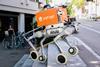
It can bound up a staircase, whizz along at 14km an hour, open gates, dodge (actual) dogs, carry 30kg of food, cover 30km on a single charge and cross the road safely. It can also navigate autonomously from store to a customer’s door in rain, sun or snow, and “master mobility, manipulation, and autonomy tasks in just days”. And all “without getting stuck”.

The Rivr One ‘robo-dog’ is currently being trialled by Just Eat in Zurich, delivering takeaways across the city. More will be rolling out across Europe later this year.

Little by little, more and more elements of the grocery operation are being handed over to robots. While Just Eat and Rivr’s robo-dog pilot and futuristic humanoid robot launches (see box below) are capturing the public’s imagination, behind the scenes, robots are increasingly running the show in storage facilities, distribution centres, on the roads, in the backs of stores and even on the shop floor.

And their numbers and responsibilities are growing by the day. “The grocery industry is on the cusp of a robotic revolution,” says Julian Skelly, managing partner, retail at Publicis Sapient. Some are calling this ‘the year of the robot’.

So, what’s driving the revolution? What are all these robots up to? And what does the future hold for shoppers, businesses – and us as humans?

JET-Robot-1

As Marko Bjelonic, CEO of Rivr, explains, the Swiss company’s trial provides “a glimpse into a future where automation blends naturally into our cities, helping people get what they need, when they need it. We give one human the power of a thousand.”

Undoubtedly, of all the pressures pushing grocers towards greater adoption of robots, “labour is the biggest”, says James Palmer, VP of automation and robotics at Strongpoint, which works with Sainsbury’s in the UK and ICA and Co-op in Sweden.

“It’s increasingly difficult to find and retain staff for repetitive, physically demanding roles in warehouses and stores, while wages and operating costs continue to rise,” he adds. “With grocery margins so tight, inefficiency is simply unaffordable.”

The BRC estimates government policy will add £7bn to retailers’ outgoings this year from higher employment costs (see graph below) Inflation-driven sales growth is “barely touching the sides” in covering the rising costs. “You can model margin all you like, but people always dominate the cost stack,” says Vineta Bajaj, incoming CFO of Holland & Barrett, formerly at Ocado. “And it’s not just salaries. There’s sick leave, paid time off, variable throughput, error rates, feelings…”

“People still matter: a careful balance of human and robotic collaboration will still be important”

At the same time, the barriers to entry of robotics rollouts are falling fast. “In the past, automation meant committing hundreds of millions to a single mega-project,” says Palmer.

Those projects still have their place, though. After all, the advantages of a single robot scale exponentially when there are hundreds.

M&S last month announced it was making a £340m investment into its food supply chain and building a 1.3 million sq ft “advanced automated food DC”.

Project Silver 04

According to Alex Freudmann, MD at M&S Food, the Northamptonshire site will feature “the latest, proven automation”, including an automated pallet crane for handling long-life ambient products, high-speed shuttle system for sorting and storing stock, and a hands-free picking solution that loads items directly on to store-ready delivery cages.

“By using this automation, we’re future-proofing both our business and UK retail logistics,” he adds.

Meanwhile, 430 ‘T-sorting’ robots are becoming operational this month at THG Fulfil’s Manchester warehouse facility, a move projected to increase operational capacity by approximately 75%. Tom Killeen, COO, THG Ingenuity, says its use of “industry-leading, scalable automation solutions” allows it to “optimise everything”.

Hi, robot: the humanoids are coming

GettyImages-2180955568

They pop up all over science fiction: from Isaac Asimov’s I, Robot to Futurama’s Bender. Think of a robot and it’s likely you’ll picture a humanoid, with two arms and two legs, that stands and walks and talks.

Several companies are working on bringing such robots to life.

Elon Musk said last year Tesla’s Optimus general-purpose robot would begin work in its factories this year. In May, Musk told a conference the bot would be the “biggest product of all time”, for which demand “will be insatiable”.

China’s Unitree Robotics last month unveiled its humanoid R1 bot, priced at only £4,400 – though potential buyers are “strongly advised to thoroughly understand the limitations” before purchasing.

So what exactly will they do? Well, it’s not yet entirely clear.

“Unlike the traditional industrial robots market, where mature applications have been developed, humanoid robots have enormous potential as a general-purpose automation platform,” says Interact Analysis analyst Marco Wang. “However, determining which specific scenarios will see them create significant productive value autonomously, and achieving efficient, reliable, scaled deployment, requires further exploration and validation.”

Robotics company Figure envisages its bots’ initial jobs will be in manufacturing, logistics, warehousing and retail, “where labour shortages are the most severe”, but will eventually be able to perform practically any task set “that humans don’t want to perform”, says the company’s founder and CEO Brett Adcock.

That includes building the robots. “Over time,” he adds in the startup’s masterplan, “humans could leave the loop altogether as robots become capable of building other robots.”

Recently released footage of Figure’s robots show two working collaboratively, putting away groceries into a fridge and drawers. Last month, it learned to fold laundry – “mundane for a person, but this is one of the most challenging, dextrous manipulation tasks for a humanoid robot”.

They’ve a long way to go, but they’re getting there fast, one clean towel at a time.

Minimal cost modular systems

But alongside these blockbuster investments, “today, modular systems make it possible to start with a small automated picking module, one robotic palletiser, or a single shelf-scanning robot”, Palmer explains.

The emergence of Robotics-as-a-Service (RaaS) models mean users can trial robots with minimal cost or commitment as well.

Jan Zizka, founder and CEO of Brightpick, whose Autopick bots pick items from totes to consolidate orders for European online grocer Rohlik Group, predicts the continued rise of outcome-linked commercial pricing models like ‘price per pick’ or ‘price per order’ to “align incentives between vendors and buyers, ultimately de-risking automation investments for buyers”.

These “novel pricing models can address and alleviate the upfront investment that’s typically required for automation, making it a more accessible option in an unpredictable economy”, he adds.

simbe Shoppers Love Tally (1)

Simbe’s Tally robots scoot up and down supermarket aisles, checking that stock is displayed correctly

The shift has already happened, says Bajaj. “It basically means for pence off your margin you could have a robot in there – versus ‘give me £5m now’. It’s a quick way to test if it works and makes it so much easier to adopt,” she says.

The models “are democratising access to automation for grocery retailers of all sizes. The previously prohibitive cost meant many smaller players were left behind,” Skelly says. “The ability to pilot robotics in a targeted area, using a few leased robots, allows retailers to validate the return on investment in their unique operational environment, fine-tune processes, and build internal expertise before making significant capital commitments,” he says.

Some call it a ‘start small, scale fast’ approach. Others call it ‘land and expand’. “We’ve seen pilots pay back in under 12 months, something impossible with the old mega-project approach,” says Palmer. “This agility is changing the adoption curve in our sector.”


Read more:


It’s not completely plain sailing, of course. Some hurdles are technical. Few automation technologies can handle frozen products, for example.

“Given the limited market size, which accounts for only 10%-20% of retail volume, there’s few vendors putting in R&D resources to address this,” says Zizka.

Nevertheless, in September, Strongpoint installed the world’s first AutoStore grid system with a frozen zone for Haugaland Storhusholdning, part of the Norwegian food distribution group Dlvry. It can operate in temperatures as low as –25°C.

“Similarly, it’s difficult to fully automate the picking of fresh produce like fruit & veg, as it still requires the human touch for delicate handling,” Zizka adds.

But this is being solved, too. Ocado’s on-grid picking arms are presently picking about 40% of the online grocer’s SKU range. It expects to hit 80% in the next few years. Last year, its 100-strong On Grid Robotic Picker arms picked more than 30 million items. By the end of this year it expects to have 500 installed.

Robots: the unstoppable rise

Integration headaches

The biggest headaches come not from the robots themselves, but integrating them into wider systems.

“Integrating robotics systems with existing IT infrastructure often presents complex technical hurdles,” says Skelly. “This challenge is exacerbated by under-investment in legacy – and the addition of systems runs the risk of compounding the problem.”

simbe Tally - Freezers

Rueben Scriven, research manager at Interact Analysis, agrees that too often, “software is the main limitation”. Consolidating orders from different temperature zones, in a short window and ideally leaving frozen and fresh items to the last moment, is “a very complex logistical operation with different pick operations. The result is automation is often not the bottleneck but rather the consolidation of the various items that are picked from different zones,” Scriven adds.

He describes one UK grocer installing a micro-fulfilment centre with a pick-rate of 600 items per hour, “but the overall system throughput was only ~200 items because there were other bottlenecks in the system”.


Read more:


This is where AI – and its ability to quickly generate software that connects disparate systems – will be powerful, says Bajaj. “We’re at a point of looking at the most inefficient process and plugging something in very quickly. It just becomes a decision of: Do I want to automate, yes or no? And businesses can pretty much plug things in in a matter of months,” she adds.

As Paul Warren, VP for EMEA at Simbe Robotics, puts it: “The challenge isn’t adopting robots — it’s embedding robotics into the operating fabric of the business. Those who navigate change management, data integration, and vendor selection successfully are the ones seeing transformative results.”

Autopicker with Giraffe (light)

Brightpick’s  Autopicker 2.0 robot was launched in June, delivering an average 70-80 item picks per hour

So, how far can roboticising grocery operations go? Grocers like Morrisons are handing over processes to robots bit by bit. In April, it became the first UK retailer to invest in Simbe’s Tally robots, which traverse store aisles multiple times a day, using AI and computer vision to “check that the products on the shelves are being displayed correctly and are legally compliant”.

“It’s a crucial but time-consuming task, so Tally aims to allow more time for colleagues to focus on customer service,” Katherine Allanach, Morrisons technology manager, told The Grocer at the time.

“Robotics and shelf-digitisation technologies are no longer a novelty; they’re becoming core infrastructure,” Warren says. As well as the availability improvements, “more than 50 labour hours per store per week are redirected from repetitive audits back to customer service”, he adds.

Late last year, Morrisons installed several palletiser robots at its Rushden DC. Previously, workers manually stacked heavy potato crates on to ground-level pallets – supermarket partner Brillopak’s robots now handle that at a rate of 20 crates per minute.

“Automating the line has resulted in us reducing our labour headcount by approximately 90% and consequently our over-reliance on agency staff that are less familiar with our production processes,” says Andy Day, site manager.


The ‘Gold standard’: no humans

The “gold standard” for automation, at least pre-shop floor, is to take humans out of the loop completely. “The idea of a completely automated, ‘lights out’ grocery warehouse is now technically achievable,” says Danielle Dakin, global market development director for grocery and 3PL at Dematic, which works with Tesco, Pepsico and Asahi.

“The core technologies are all available today. But people still matter: a careful balance of human and robotic collaboration will still be important,” she adds.

HMB852

Bajaj agrees the industry is “within reach of fully automated, ‘lights-out’ fulfilment centres in grocery. And the technology is no longer theoretical, it’s operational. There was a time when people were essential at every step, especially when it came to produce quality, careful handling, and reactive thinking. And yes, there are still tasks where a human touch matters – for now. But we’re long past the point where grocery needs to rely on people for every part of the fulfilment chain,” she says.

Humans are “likely to remain necessary for handling exceptions like damaged goods and labelling errors, ensuring product quality, managing equipment maintenance, introducing new items, and adapting to sudden spikes or shifts in demand”, says Skelly.

But, undoubtedly, fewer and fewer will be needed as the robots march on.

“This isn’t about being ‘anti-human’,” says Bajaj. “It’s about being pro-efficiency in a category where net margins are often less than 3%. So no, automation isn’t optional. It’s the infrastructure that makes online grocery work, at scale and at profit. How many humans do you actually need? The answer is: as few as you want. The real question is how much you’re willing to invest to get there.”