







Just because you ate it for your school lunch, doesn’t mean your kids should. That’s the message food education charities have been arguing for years, and it’s finally paying off as the School Food Standards – the rules about the food and drink that schools can provide – are getting “the most ambitious overhaul in a generation”.
While the education and catering sectors have widely welcomed the changes – which include a complete ban on deep-fried food – Stephanie Slater, CEO of School Food Matters, says there continues to be “so much nostalgia around crap school food”.
Whether you remember school food fondly or with dread, the Turkey Twizzlers, rectangular pizza, jam roly-poly and classic sponge cake topped with icing and sprinkles make it unlikely you’ll remember it as being particularly health-focused.
“I had deep-fried luncheon meat fritters in my school and powdered mashed potato,” Slater recalls.
‘It didn’t do me any harm…’
On a personal note, I started the school day with a greasy bacon roll at break, followed by a chicken burger for lunch and a chocolate brownie to finish, washed down with a milkshake chaser. Not a single piece of fresh fruit or veg to be seen. It might have been the norm at the time, but looking back, it was absolutely bonkers.
“People talk about bad school food as if it’s funny or a good thing, and it’s not. It’s not supporting children’s health,” Slater says. “We need to change the narrative on that and celebrate the good stuff that’ is going to help children to learn.”
According to the National Diet & Nutrition Survey, over 10.5% of children aged four to five start school with obesity. By the end of primary school, this rises to 22.2% – almost 30% in the most deprived areas.
Children currently consume twice the recommended amount of free sugars, with only 8% of primary and 5% of secondary pupils meeting guidelines. Meanwhile, dental decay is now the leading cause of hospital admissions for five to nine-year-olds.
A change is needed now more than ever.
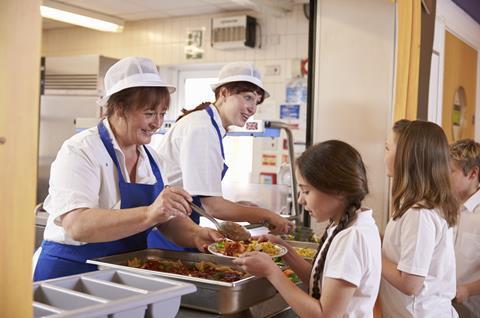
The deep-fried ban
Under the new plans, which have been set out in a nine-week consultation, schools will not be able to offer unhealthy grab-and-go options such as sausage rolls and pizza without also including a portion of veg. Deep-fried food will be banned entirely and puddings will have to be made of at least 50% fruit, with these healthier options being served instead of “sugar-laden treats” – although cake will be allowed once a week.
Even fruit juice will be taken off the menu, with squash to be banned in primary schools.
The revolutionary changes also pave the way for the first vegetarian state schools, as the proposals would also mean that beans, chickpeas and lentils can be served as an alternative to meat and poultry.
Crucially, changes to the menus must be appealing to children, otherwise there is a risk they begin avoiding school meals entirely, in favour of an (often less nutritious) packed lunch.
Sample lunch menus currently include spaghetti bolognese, Mexican-style burritos, cottage pie with root veg mash, jerk chicken with rice and peas, and a roasted chickpea, vegetable & mozzarella wrap. So far, so wholesome.
‘Better is possible’
Slater says the biggest challenge now is education. “There’s an opportunity here: 190 days in school means 190 opportunities to feed children well and teach them about food.
“If we’re trying to teach them about growing food, cooking food, eating well, but serving them crap in the canteen that just doesn’t make sense, there’s no logic to it. We need to be modelling good behaviour.”
According to Slater, this absolutely can be done. It is something School Food Matters, along with four other UK food and education charities – Bite Back, Jamie Oliver Group, Chefs in Schools and the Food Foundation – are working on at a nationwide level, under the banner of the School Food Project.
“We’re going to create 50 beacon schools – schools that are doing it really well because we’ve helped them along the way. We’ll help them with the engagement piece, with the training, with the architecture in the dining room and all those things that need fixing.”
From September, these schools will be provided with £45,000 of support for specialist food resources and training of staff and catering teams, plus engagement programmes for pupils and families.
They will share learnings with 450 ‘cascade’ schools in their local areas. The School Food Project also promises help to all 23,000 schools in the UK with support on the updated framework.
“The idea is that over five years, we are able to build an evidence bank to say better is possible,” Slater adds.
Ultimately, by September 2028 (when secondary schools will also adopt the updated standards), much of the school food we once loved (or loathed) will be a thing of the past. The only question left is whether or not the government can ensure healthy food also means tasty food that notoriously picky children will actually eat…





No comments yet