










Bringing a company back from the dead is no easy feat. And doing so under the full glare of the public markets and watchful eye of activist investors only adds to the pressure. Just ask Alex Whitehouse. He was tasked with reviving the Premier Foods zombie.
The Mr Kipling and Bisto owner had been brought to the brink of collapse following a reckless, acquisition-fuelled expansion programme started in 2004. By 2008, the group’s debt binge, which included buying Ambrosia, Quorn and Hovis, took its obligation to lenders to £1.8bn. A £600m shortfall in its pension schemes also hoovered up any spare cash. Its stable of household brands went unloved as a result, with all resources funnelled towards keeping the business afloat.
Whitehouse took over as CEO in 2019, promoted after activist shareholders forced out his predecessor Gavin Darby. He had already spent five years inside the business in various management roles, so knew exactly what he was inheriting.
Looking at Premier Foods today there’s little evidence of those past traumas. It rejoined the FTSE 250 after a lost decade in 2020, resumed dividend payments after a 13-year hiatus in 2021 and struck a landmark agreement in 2024 to combine all its historic pension schemes into one trust, making onerous deficit contributions a thing of the past.
Trading profits of £200m beat City expectations for the latest year to 28 March 2026 as branded revenues rose 3.4% to surpass £1bn (up from £679m the year Whitehouse took charge) and debt fell to an all-time low of just £95m.
The impressive turnaround landed Whitehouse with the Grocer Cup at this year’s The Grocer Gold Awards. Sitting in Premier Foods’ wood-panelled boardroom at its St Albans HQ, Whitehouse is modest while reflecting on his achievements. “One person on their own doesn’t deliver this kind of transformation,” he points out. “It’s a massive team effort. We’ve got more than 4,000 people who really pulled together.”
He also highlights groundwork laid by Darby, who captained the company through tumultuous waters, including a hostile takeover battle with US spices supplier McCormick in 2016, for more than eight years before making way for new leadership.
Whitehouse initially joined Premier as boss of the grocery division in 2014, with a remit to get brands such as Batchelors, Bisto and Oxo growing again.
Whitehouse had learned the value of brand building during 18 years at Reckitt Benckiser. “I grew up in Reckitt, which was great at making brands grow. It was great at innovation, NPD, marketing and advertising. I brought a lot of that with me into Premier Foods.”
It’s here the seeds of the ‘branded growth model’ – a strategy centred on product innovation, effective marketing and closer ties with supermarkets – were planted. “The biggest facilitator of the turnaround was getting those brands growing in a consistent, reliable way,” he says. “The innovation programme is now a crucial part of the branded growth model and is a cornerstone of how we run the business.”
And it worked. Brands clawed their way back to growth, and Whitehouse was made UK MD in 2017. The following year, a complete relaunch of Mr Kipling showed the power of the new model, as a new ad campaign, updated packaging and on-trend NPD took the company’s biggest brand into double-digit growth.
“It’s great having strong brands, but you’ve got to support them. At first, we didn’t have much money to spend, so we had to eke out the investment. As we’ve grown, we’ve been able to put more money behind the brands, and, frankly, behind our people as well.”
Back on the acquisition trail
An unexpected boost came in 2020 as Covid shook the world. Despite presenting major challenges, the pandemic swelled Premier’s coffers as locked-down consumers turned to its cooking sauces, noodles, stock cubes and gravy granules. The extra cash helped pay down a bigger chunk of debt than expected and paved the way for Premier to get back on the acquisition trail.
First was the £44m takeover of The Spice Tailor in 2022. A £34m deal to buy Fuel10K followed in 2023, and, last year, a £48m acquisition of Merchant Gourmet complemented moves in the rest of the portfolio to widen its offering of healthier products. Revenues from this trio are expected to total £100m this year.
Whitehouse has learned from Premier’s past M&A mistakes, and the group is now “super fussy” about targets. “We’re very, very rigorous, because we’re looking for the brands of the future. We’re focused on consumer trends and the ability to build the brand using our branded growth model. So, if I think we can apply our skill set and we’re going to unlock the next level of growth, then that’s when things get on our radar.”
While that radar is not exclusively scanning for better-for-you brands, Whitehouse admits the long-term trends point towards consumers wanting to eat more healthily. And Premier has invested heavily to cater to that demand through years of reformulation.
“We sell millions of products a day, so if we can make those products a little bit healthier, the cumulative impact on the nation’s health is not insignificant. We felt there was a moral obligation to do that. We’ve reduced salt, fat, sugar. We’ve put in more fibre, protein and made more products one of the five a day
“I’m not sitting here thinking we largely make stuff that’s bad for you. I don’t think that’s the case. Yes, we also sell cake, and cakes are treats, but life would be pretty dull if we couldn’t have the occasional treat.”
Name: Alex Whitehouse
Place of birth: Yorkshire
Lives: Split between West Sussex and St Albans
Age: 56
Family: Married to Alison, we met at uni (York); two grown-up children
Potted CV: Joined Whitbread on the graduate scheme in marketing, spent 18 years at Reckitt, before joining Premier Foods
Career highlight: Premier Foods re-entering the FTSE 250 in September 2020
Best advice you’ve ever received: “If something’s worth doing it’s worth doing well.” That’s from my late mother and it’s stuck with me all my life
Book you’re currently reading: The Red Hand by John Broome
Hobbies: Reading, sailing, travel
Dream holiday: Travelling in Asia
Favourite album: O by Damien Rice
Favourite book: Midnight’s Children by Salman Rushdie
Favourite Mr Kipling product: Our new tubs of cake bites
The proof is in the pudding. Sales of non-HFSS Premier products increased 16% during the 2025/26 financial year, with the business hitting a 2030 target for more than 50% of its offering to meet high nutritional standards for registered health or nutrition benefits ahead of schedule.
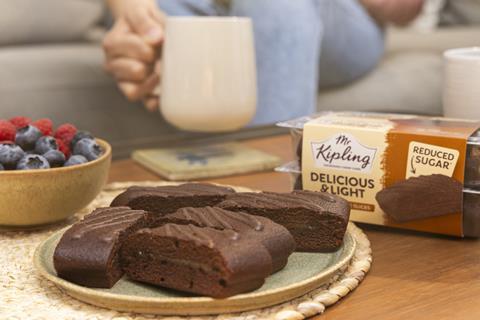
Even in cake, Premier is doing its bit, with Mr Kipling Delicious & Light slices reducing sugar by 40% and saturated fats by 70%, while adding fibre and weighing in at 99 calories each. Consumers clearly welcomed the innovation, as FY2025/26 was Mr Kipling’s biggest ever.
Nonetheless, the new cakes could be dragged back into the unhealthy bracket and banned from running promos and TV ads if mooted government proposals for a tougher nutrient profiling model come into force.
Whitehouse won’t be drawn on whether it’s fair for legislators to move the goalposts for the industry after so much reformulation work has been done. Like every hurdle he faces, the Premier boss appears unfazed, ready to take whatever comes in his stride. “I don’t think it’s my job to second-guess government legislation,” he says. “Our job is to run the business and try to do the right thing for the consumer at the same time.”
But he does want the government to continue incentivising food manufacturers to act responsibly, which he says is what led to Delicious & Light in the first place.
Doing the right thing was at the heart of Whitehouse’s turnaround from the very start and informs all three pillars of the group’s Enriching Life Plan – an ESG strategy for products, planet and people. Alongside its focus on health, Premier is recognised as a leader in farm animal welfare, securing a Tier 2 accreditation with the Business Benchmark for the past three years. It also aims to reduce its environmental impact by lowering emissions, with a £2.1m investment in a new solar farm at its cake factory in South Yorkshire.

“Initiatives such as the solar farm at Carlton are great in terms of reduced environmental footprint, but it’s also free electricity, so there’s a fantastic commercial benefit at the same time,” Whitehouse says. “I’ve found if you don’t cut corners and do the right thing over the long term, you can deliver great business success.
“That means taking care of all stakeholders, whether it’s our colleagues, or doing right by consumers on health and, when we can, in communities – including our work with Felix to redistribute a million meals over five years while also halving food waste by 2030.”
Such long-term thinking has helped Whitehouse navigate a pandemic, ingredient shortages, significant inflation and now a war in the Gulf. “You’ve got to deal with these things on a day-to-day basis. But what you can’t do is lose sight of the long-term game plan,” he says.
With the Premier Foods turnaround firmly in the rear-view mirror, Whitehouse can look forward once more. “This is the exciting part,” he says. “The hard work’s been done. With balance sheet strength and a bit of momentum behind us, we’ve got the opportunity to build a much bigger version of Premier Foods than the one we’ve got today.”






No comments yet