



With Trump’s America increasingly unstable, China is emerging as a major export opportunity for British food and drink brands. How can they make it work?
President Trump is more unpredictable than ever. That’s hurting trade just as much as the special relationship. Exporters tell The Grocer the US is becoming a less attractive partner in the face of ongoing tantrums and tariffs. The threat of further disruption is especially strong as Trump looks for political leverage to strongarm allies into war with Iran.
By contrast, China is presenting itself as a more stable partner. Both the UK government and British businesses are eyeing the market more seriously.
“For a decade, there’s been a lack of serious engagement to capitalise on the opportunity of a better relationship with China,” said business and trade secretary Peter Kyle ahead of Keir Starmer’s visit to Beijing in January. “We want to see trade flourish between us.”
The fresh efforts could unlock a major opportunity. China is one of the “most compelling consumer markets globally”, says foreign investment consultancy Dezan Shira, “driven by its vast population, rising incomes and structural shifts toward urbanisation and consumption”. Furthermore, the “country’s middle-income population exceeds 400 million, creating a demand base larger than the entire US population”.
So, what is the appetite for UK food and drink in China? How can brands and suppliers boost their appeal? And what does it take to get a foothold?
‘Made in Britain’ still has cache in the country, but while “British heritage, British craftsmanship and British provenance count, you need to articulate why that matters”, says Antoaneta Becker, director of consumer economy at the China-Britain Business Council.
“If I’m, say, an urban millennial in Shanghai, why does British provenance count to me? What is it that triggers my discretionary spending on a premium British product – which is much more expensive – when there’s an alternative local product, which will also be good quality?” she asks.
High-end Somerset ice cream brand Granny Gothards is one example of how to successfully communicate that appeal. It was first sold in China seven years ago, having been scouted by a local retailer that sells a curated pick of global products. The brand is now preparing to list at Sam’s Club, the Walmart-owned warehouse retailer with about 60 stores in the country.
“There’s still massive trust in British products. What you can’t do is take a rubbish product, stick a British flag on it and expect it to sell,” says Amanda Ringelberg, Granny Gothards CEO. “You’ve got to have a quality product with provenance, a clean ingredient deck, that’s different from all the other products out there. After all, it’s going to cost a premium on the shelves, and Chinese consumers are very savvy.”
Those consumers – especially younger generations – “prioritise quality, authenticity and eco-friendly products”, Dezan Shira reports. But local producers are meeting those demands too. Convincing a shopper to buy British, then, “requires a storytelling element to every product we sell”, Becker says.
Luckily, the increased adventurousness of Chinese consumers means they are more open to those stories.
“Tastes are changing, with a shift to more western products,” points out AHDB’s head of international trade development Susan Stewart. Take cheese. A decade ago, Chinese consumers would have “made a face and said: ‘I’m not sure I like that’”, she says. But their fondness for fromage is growing. Demand for other European-style dairy, such as yoghurt and yoghurt drinks, has similarly surged in recent years.
In the case of cheese, it’s increasingly seen as an accompaniment to wine, says Stephen Jones, founder of cheese exporter Somerdale International.
Tastes vary from Barber’s 1833 cheddar to spicier fare such as Norseland’s Mexicana. Somerdale is also looking to push American-style cheeses, perfect for burgers, amid a hike in Chinese tariffs on US imports. The push is paying off. Somerdale has gained listings in major retailers such as Sam’s Club and Costco, meaning China now represents about 10% of its turnover.
Starmer’s pursuit of a ‘pragmatic relationship’ with China
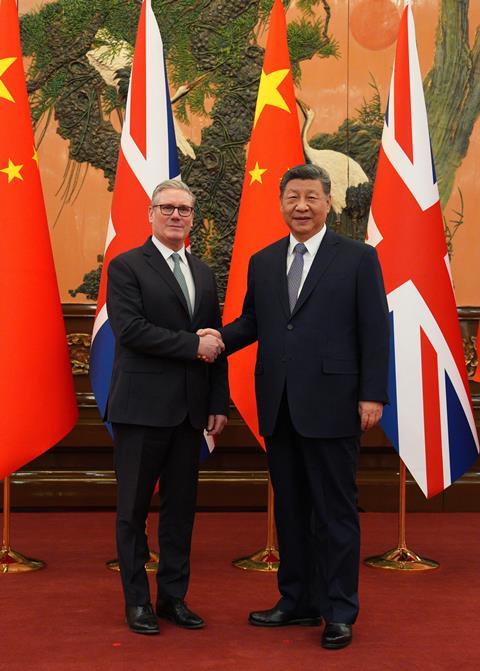
Keir Starmer (pictured with President Xi Jinping in Beijing in January) said the cut in Chinese import tariffs to 5% – alongside a wider reset in relations with the country – was “how we secure growth for British businesses”.
The agreement would be worth up to £250m to the UK economy over five years, he added. The wider benefit of Starmer’s visit to the Chinese capital was said to be worth more than £2bn, while UK citizens also secured visa-free travel to the country, with the government now pursuing a “pragmatic, clear-eyed relationship with China”.
China remains a key outlet for British pork, too. It is second only to whisky as the UK’s largest food and drink export to China, according to the most recent analysis of full-year HMRC data by the FDF. Particularly popular are ‘fifth-quarter’ products such as offal, trotters and pigs’ heads. Indeed, offal sent to China accounts for just shy of 30% of the UK’s total pigmeat exports.
“Just because these kinds of products are not valued [by consumers] here in the UK, doesn’t mean they’re not valued elsewhere,” Stewart says. “When you walk into a retailer in China and other markets across Asia, you’ll see products such as feet beautifully packaged, beautifully packed and really well-presented.”
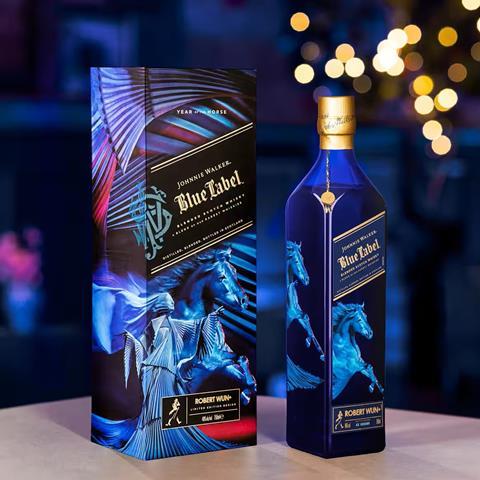
Trickier to navigate is the market for brown spirits, given the dominance of China’s favourite white spirit baijiu. “The total spirits category in China is huge, but 97% of that is made up of baijiu sales, with just 1% scotch whisky and the remainder cognac,” notes Tom Russell, head of international business development at Glengoyne whisky owner Ian Macleod Distillers.
Nonetheless, there are “exciting” opportunities for exporters of scotch, Russell argues. That’s been aided by the fall in whisky tariffs from 10% to 5% in February. While the move won’t be a “golden bullet”, it’s a “significant step in the right direction, and hopefully it will increase demand for whisky”, he says.
“We’ve seen a huge spike in whisky distilleries opening in China,” he adds, which should “normalise the consumption of brown spirits over white”. As such, Ian Macleod recently opened an office there to help co-ordinate exports and build relationships with buyers.
The luxury, high-quality connotations of whisky could prove a particular advantage. A December report by Bain and Worldpanel found fmcg spending in China is growing and volumes are up, with consumers “balancing affordability and small indulgences”.
“The moderation of price deflation and steady volume growth indicate that China’s fmcg market is moving towards a new normal where consumers are pursuing value rather than pure price,” says Rachel Lee, general manager of Worldpanel China. “We’re seeing greater balance between affordability and quality across categories. Brands that understand these expectations and calibrate pricing and promotion strategies accordingly will be best positioned to sustain growth.”
Domestic brands and preferences
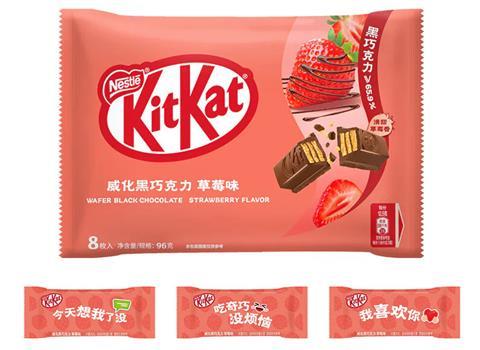
Still, competition is fierce. “Local competition is so agile, so attuned to what their consumers want, and they’re so much faster at iterating,” says Becker at the China-Britain Business Council. “That’s the key challenge. It’s not regulatory, it’s not any geopolitics – it’s local competition and their understanding of what Chinese consumers want.”
Plus, exporters aren’t just competing with local brands. Chinese retailers are waking up to private label, which accounted for 2% of fmcg sales in 2025. That equates to 44% growth over the past two years. Such items are “capturing incremental demand while intensifying competition for branded manufacturers”, the Bain/Worldpanel report says.
The Guochao movement is another factor to consider. Born during the pandemic, it was initially about supporting domestic brands over imports. It has since evolved into celebrating Chinese innovation and taking pride in cultural heritage and regional identity.
That could be a bad omen for imported brands. Yet for exporters, their international credentials are a selling point, even in the Guochao era.
A spokesman for JD.com, China’s biggest retailer by revenue with 700 million active customers domestically, says the “ appetite among Chinese consumers for British and European products remains robust, with a clear preference for quality and niche appeal”.
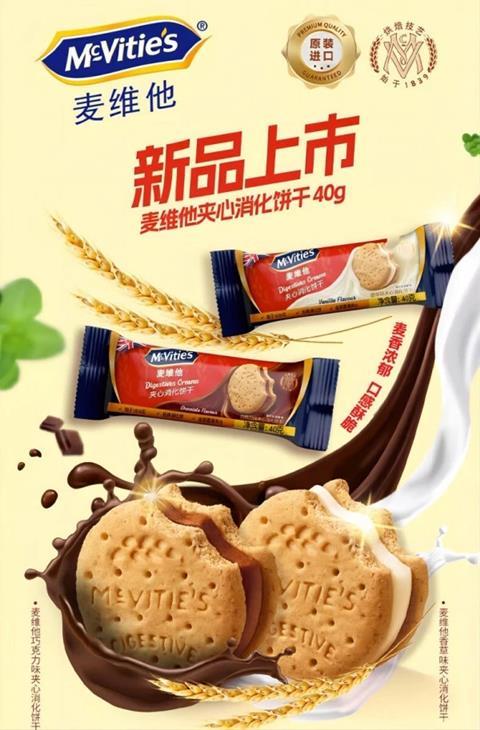
Data from JD’s cross-border import platform shows steady growth in UK food and beverage categories that focus on natural ingredients and regional authenticity.
“This demand is primarily driven by a consumer shift toward quality and traceability. Chinese shoppers increasingly prioritise authenticity and strict production standards, making natural and organic labels essential purchasing criteria,” the spokesman adds.
“There’s also growing interest in ‘hidden gem’ brands that offer a specific heritage or local flavour, allowing consumers to explore products beyond mainstream options.”
Many needn’t even translate their packaging for the local market. “All products sold in China come in identical packaging to that in the UK,” says Stew Wilson, business development manager at Vitabiotics China. “Chinese consumers want the exact products they know are trusted and popular in the UK.”
Granny Gothards backs up that point. In the case of Sam’s Club, “they didn’t want any translations on it. They want it to look imported”, Ringelberg says.
That, of course, needs to be married with local expertise. For that reason, brands will often work with partners based in China. There’s a persistent mindset that it’s best to delegate growth in China because “it’s a difficult market. I don’t understand it. Different time zone. I don’t speak the language,” Becker says. However, “that’s not viable any more”.
Brands hoping to find a distributor who will simply “take my worries away and deal with China” will be disappointed, she adds. “That model is so outdated. You need to work with them to co-create content, to launch brand collaborations that stand out in the market. That’s a true partnership, and that’s what’s changed. Before, it was a distribution relationship – now it’s a brand partnership,” Becker explains.
That means finding a sound partner is ever more crucial to success. “Local expertise and native speakers are essential to operating in China,” says Vitabiotics’ Wilson. “A trade partner can provide this, but it’s crucial to carefully vet them, check references and ensure they deliver as promised. Once partnered, monitor margins and costs closely to keep the collaboration profitable and sustainable long term.”
It’s also telling that Vitabiotics has reaped rewards solely from online selling, rather than going into physical stores. Given the sheer scale of the market, online is a huge opportunity. Online retail’s share of physical goods in China was 26.1% in 2025, according to the National Bureau of Statistics of China. That’s a similar proportion to the UK, where the figure stood at about 27.5% for 2025 [Office for National Statistics]. Online grocery penetration in China is around 10%, versus 13% in the UK, sources suggest.
The major online retailers are making it easier for UK brands to capitalise. JD.com, for example, has established “several structured pathways designed for rapid scaling”, which “ensures a streamlined path from the British production facility to the Chinese doorstep”. For the right products, it could be as straightforward as dropping off stock at a JD.com warehouse in the UK. “From there, our logistics business handles the international freight, customs clearance, bonded storage and final delivery,” the spokesman explains.
Speed and patience
Overall, trading in China requires a unique mix of speed and patience. “The first thing about doing business in China is forget everything you know about business,” says Jamie Sergeant, Global CEO of Crowd, an agency that helps brands expand into new territories. “If you think you can just sledgehammer your way in as a westerner with ‘this is how we do business’ – no. You do business how they do business and that’s how you succeed.”
Speed of response is a key part of that. “If there’s one word to sum up doing business in China, it’s ‘fast’,” says Wilson. The vitamin company has been in the country for a decade, initially selling online on Tmall Global. In 2019, it established a dedicated local China office and today runs 16 online stores across six major marketplaces from their Chengdu office with 30 staff.
“Consumers and distributors expect stock, information and contracts immediately, so we’ve had to accelerate processes and be extremely flexible,” Wilson says. “The market simply waits for no one.”
Another part is getting on top of the paperwork – whether regulatory approvals or customs papers. That’s where the patience comes in. Somerdale’s Jones has spent over a decade building an export business in China with a Shanghai-based import partner called London Food, run by Alexander Macdonald, a Scot.
“It’s all just a case of getting it right,” he says, pointing to the need to ensure documentation is correct to the extent that “you can’t put a comma where there should be a full stop – we’ve learned the hard way”.
The pair have gone through “years of torment and toil” in establishing themselves with China-based retailers and cheese buyers and navigating the byzantine regulatory environment, Jones says.
For that reason, he believes exporters should have a five-year plan and “be prepared not to make any money” for a similar period if they want to establish themselves in the country.
That need for a slow burn mindset is also hammered home by Russell of Ian Macleod: “The potential is huge, but it’s going to take time and you’ve got to be patient.”
Essentially, it comes down to a persistent, long-term view, sums up Becker. “It takes longer than other markets. And then it’s never the case that you’ve got it and you can just file China away. International brands often fail to grasp how much the consumers themselves could change, how much the retail environment has changed, and what consumers are looking for.
“[Brands] have got to have the patience, the time, the resource and the commitment. You consistently have to work on innovating there, putting out new products because the competition will be there before you. But for brands that have got China firmly in their sights, the opportunity is there.”
WeChat to Weibo: essential marketing tools
Building a brand in China and marketing to its consumers “requires a completely different approach”, says Jack Porteous, commercial director at Tong Global, which works with Taylors of Harrogate, Clinique and Tiffany in China.
The unavailability of Google, Facebook, Instagram and Amazon there means there’s an “entirely distinct information ecosystem”, with the product discovery journey happening on local social media channels.
WeChat is a super-app with more than 90% penetration, used for messaging, social networking, mobile payments, and interacting with services.

Douyin, meanwhile, is the Chinese version of TikTok, focused on short-form videos and impulse-buying livestreams.
According to Porteous, Xiaohongshu (RedNote) is “often the right starting point for premium international brands – it is most similar to Instagram, with a curated lifestyle focus and a culture of everyday users sharing reviews and recommendations”.
Weibo is often called the Chinese Twitter and functions in a similar way, while Bilibili is the ‘YouTube of China’, popular among Gen Z for anime, gaming and user-generated content.
Whatever the platform, livestreaming influencers – “from major celebrities and internet-famous influencers, through to rural Chinese workers who promote their local town’s produce” – have become “an integral part of any brand’s go-to market strategy for China e-commerce”, Porteous explains.
Chinese consumers are increasingly accustomed to the “watch-and-buy” shopping model. On Douyin, food and drink is the second-biggest-selling category after fashion for sales on the platform. Livestreaming accounts for close to half of all sales there.
Vitabiotics manages a presence on all major Chinese social media platforms and has long tapped the potential of livestreaming to promote products and “reassure consumers that they’re buying top-quality products”, says Stew Wilson, business development manager at Vitabiotics China.
Most of all, though, to make marketing in China work, “moving at China speed is essential”, says Porteous.


No comments yet